The disappeared civilization is one of literature’s favorite tropes. And the Maya are among the most referenced real world examples of these civilizations. Their long lost cities buried deep in the forests in remote regions of Central America, overgrown with vegetation, often remote from farmlands or water sources. Their architecture is both alien and familiar, temples are built on massive scale, and their Gods seem a combination of animals, humans, and abstract thoughts. And yet all that they were has been swallowed by the jungle. No trace left but the massive ruins of their once mighty cities.
It is a cool story, and of course, almost entirely fiction. Yes, the once great cities of Northern Guatemala and the Yucatan have been abandoned, but as for the disappearance of the Maya, well the ones on my boat in Lake Atitlan would indicate otherwise. For thousands of years, the Mayan people have lived in Central America and the Yucatan, and there they still live. When Cortez began his conquest of Mesoamerica, he first encountered the Maya. 90 years after the founding of Jamestown, the last free Mayan city on the island of Flores fell to the Spanish. The Spanish embarked on a cultural genocide; destroying Mayan writings, temples, shrines, banning Mayan languages.1 But they failed in this unholy quest, the Mayan people still exist, over 30% of Guatemalans still speak a Mayan language as a first language. Even Christianity couldn’t defeat them. Catholic missionaries finally accepted a fusion of beliefs when total conversion proved impossible. Today the Mayan people live in traditional villages in the Western Highlands of Guatemala, wearing traditional garments and practicing their ancient weaving arts. They inhabit the villages and towns of the rural valleys of the Eastern Verapaces. But they also live in Guatemala City and Antigua and Xela. Just as the Egyptian people live in cites next to the Great Pyramids, just as the people of Rome still surround the Colosseum, so do the Mayan people still work and play and live around the ruins of their ancestors cities. The Maya have never vanished. They have always endured.
We arrive in Panajachel after a 4 hour sparsely populated shuttle, about the peak of luxury in Guatemalan backpacker travel. I’m very nearly recovered from the Acatenango hike, though Megan is not as far along as me. Because of this, once we get checked into our room at the hospedaje,2 I head out on a reconnaissance mission. My mission is twofold: find a place to eat with vegetarian options, and find safe transit to San Pedro la Laguna on the other side of the lake. Way back in Santa Ana, El Salvador a fellow traveler named G* from Denmark3 told us horror stories of the boats on the lake. Unsecured bags thrown on the roof, cramped interiors, shoddy craftsmanship, the works. Megan had taken this to heart and was in fear most of all of her bag falling off the roof and thus being left with nothing but the clothes on her back.4 I went in search of alternatives, but discovered that while we could take a taxi, it required basically leaving the lake, driving around several volcanoes and entering San Pedro from behind the lake, a 2 and half hour and $100 adventure. The boat took 30 minutes and cost about $10 each. So after wandering around the tourist drag and forgetting my mission for the briefest of periods, I made my way down to the docks, surveyed the boats, and took a picture of the one that seemed most likely to convince Megan the water route would be fine. Having succeeded, I then took her to an Italian restaurant, because pasta makes everyone happy. The next day we checked out of the hospedaje, but decided to explore Panajachel a bit before heading for the boats.

Panajachel is the main entry point for Lago de Atitlan, a beautiful volcano ringed lake that Aldous Huxley once described as “too much of a good thing.”5 The lake shore is dotted with villages and towns with varying degrees of tourist infrastructure but everyone of them is dominated by Mayan culture.6 At least two distinct Mayan languages are spoken on the lake, with each town having its own dialect within those languages. Tourism has of course struck the lake hard, but the people of the lake seem to have simultaneously embraced this and ignored it. They go on wearing their traditional garments, carrying their groceries on their heads, happy to sell you a handwoven shirt or purse, happy to ignore you completely. Panajachel, or simply Pana, is of course inundated with hotels and restaurants, but the impression I got from our brief time there was of a city more geared to tourists from within Guatemala than towards foreigners. Almost everyone we passed on the streets was Guatemalan, Spanish was a near necessity in shops and restaurants, and “comidas tipicas” easily outnumbered Western style food. A good thing too, because for breakfast/lunch7 we ate at one such place and it was among the best meals I had in Guatemala. After the meal we wander, visiting a tiny museum and then walking along the lake before we finally collect our bags and make our way to the dock.
The thing about the boats, in addition to the previously mentioned concerns, is that they are not purely tourist affairs. Pana being one of the largest cities on the lake, and a transport hub, locals often have to use them to transit back and forth when they need things not available in their city. On our boat, for example, was a large family returning to their town with birthday supplies: cake, pinata, hats, the standards. You also don’t get to pick your boat, you take whichever one is next up and then you sit in it until it fills up, thus maximizing the profits for the boat owner. We approach our boat, asking several times if this boat goes to San Pedro la Laguna, not realizing all boats go basically everywhere as they make a circuit of the shore. A young deckhand/first mate/cabin boy/only person working the boat besides the captain who does not move from the wheel takes our bags without asking and throws them onto the much feared roof which is unfortunately not quite as reassuring as the boat in the picture I showed Megan. But we have basically no choice and are hustled onto the boat, which I should mention is not still as the wind and approaching dark clouds are creating rather impressive waves on the lake. Once we finally head out however, the ride is relatively smooth, until it starts to rain, at which point the ride is still smooth but my mind is focused on my topside bag and wondering just how water resistant it is. As I contemplate which of my clothes will be most comfortable wet I begin to notice that the birthday family is not speaking Spanish, and my mind focuses immediately on their conversation. I listen and understand nothing of the language, but I enjoy it. It is a Mayan language,8 very much alive, definitely not disappeared.
Before we left Pana I told Megan that our hostel was a mere 8 minute walk from the dock in San Pedro la Laguna and that we might as well walk. When we arrived, in the pouring rain, we immediately faced a very vertical hill leading up to the main street. I convinced her we just needed to get past this part and then it would be smooth sailing, so we did and the road leveled and then we turned down the appropriate street and we faced a steeper, longer hill. I walked in front to lead the way, but I could feel the eyes. We turned down a very creepy alley and just as I was about to apologize we turned a corner and there was Mandala’s Hostel. We checked in, signed up for a wine tasting, then collapsed into our bed.
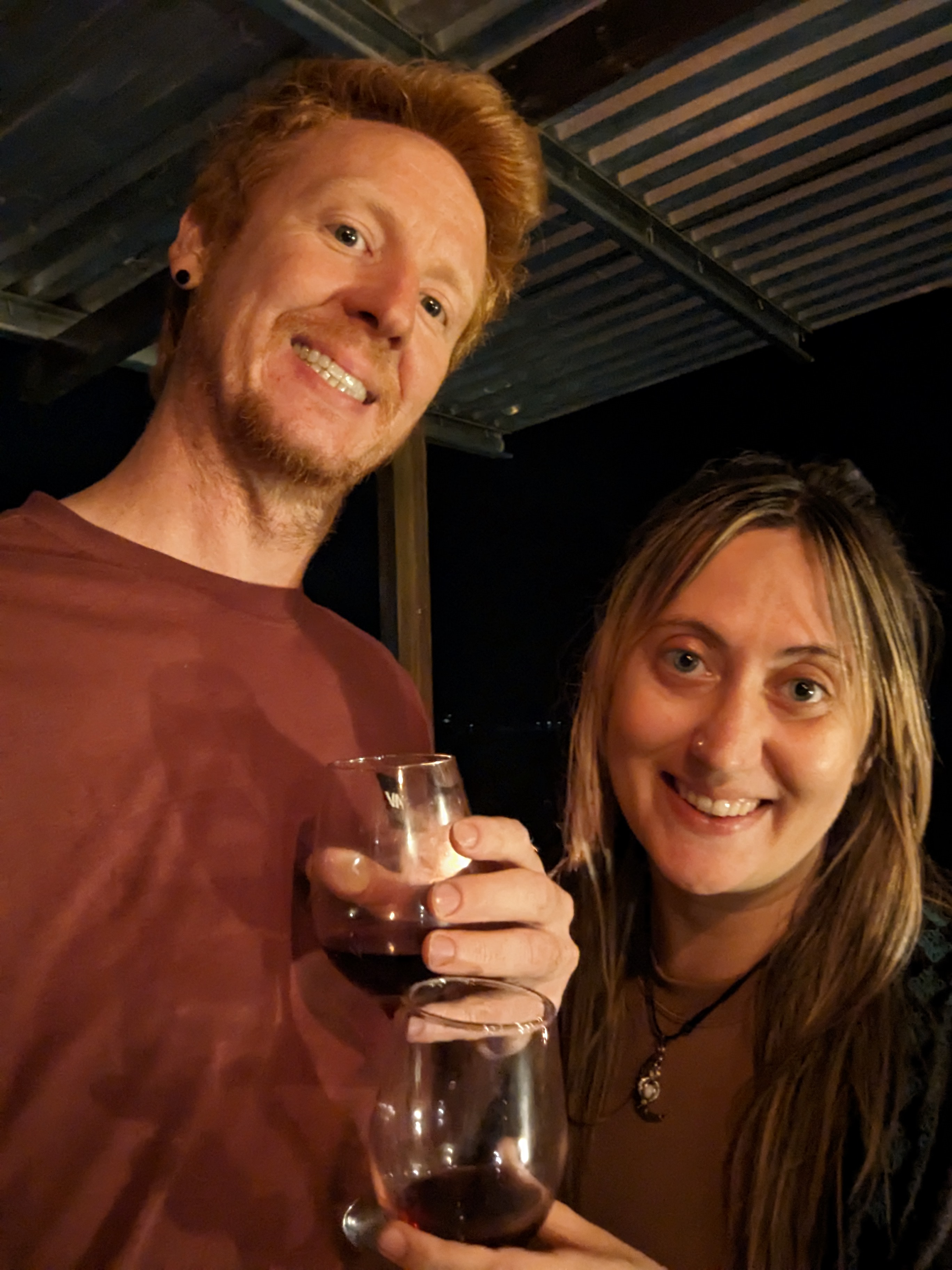
Mandalas was the kind of place that had good vibes from the start. Beer for sale but no loud bar, comfy beds, lots of places to lounge, and a nice upper level terrace. It was on this terrace that we had our wine tasting, a fantastic affair more for the change of pace and quality of cheese accompaniment than for the wine itself. Megan and I were in our element, making friends and enjoying the hostel atmosphere. It would have been a fantastic evening if not for a young Dutch girl who we met, who asked us about former travels and then said “it’s so cool that you are still staying in hostels.” Reader, I was devastated. With one statement my belief that I could still run with the hostel crowd and I wouldn’t stand out as too old was shattered. I increased my rate of drinking and sank into sadness, only slightly alleviated by meeting a local who had spent half his life in the US with whom I was able to discuss geopolitics and cultural issues. You know, the kind of stuff old people talk about. The next day was spent exploring the town, after a slow start and much coffee. This revealed that there wasn’t really much to the town of San Pedro itself; restaurants, bars, and tour offices being the primary attractions. But, I had another goal for that day, I wanted to convince Megan to go on another hike.
To say that Acatenango had not exactly gone well would be an understatement. Megan still wasn’t back to 100%, and was in no mood for hiking up steep slopes to great views, the views are just fine at the bottom thank you very much. But I was determined to avenge my Acatenango struggles, to redeem myself before my own eyes. Plus there wasn’t much to do around Lago de Atitlan, and really there isn’t much to do in Guatemala, Central America, or basically all of Latin America outside of few big cities, if you aren’t going to engage in some physical activity. I had come on this trip to be physical, to explore and experience nature, to hike volcanoes, to trek to ruins, to surf, and to just be overall active. That Acatenango had been difficult did not mean I needed to change my plans, it meant I needed to get more reps in.9 Indian Nose10 provided the perfect opportunity. A 40 minute hike that was only uphill for the last 20 minutes, that ended with a breathtaking sunrise view of the whole lake, where you were fed pan dulce and given coffee and hot cocoa, before heading down and being back at your hostel for a nap by 10 AM. So I began my sales pitch early, and after much convincing, won approval. We would go to bed early, and the next day wake up at 3:30 AM to hike Indian Nose.
We awoke the next day at the appropriate time, though not as well rested as we had hoped. For all of Mandalas charm and good vibes, its biggest drawback is its proximity to Mr. Mullets, San Pedro’s biggest, most raucous, and loudest party hostel. So until 11 we lay in seething resentment as the walls shook and the latest hits such as Afro Man and 50 Cent blared into space. We rode a little over an hour to the start of hike, which began with a lengthy downhill section, a welcome surprise until you consider what that means for the return trip. But when we reached the uphill section I knew we were in trouble. As steep if not more so than the worst of Acatenango, we struggled up the hill, though not bringing up the complete rear thanks to a few Guatemala City natives who apparently lead an even more sedentary life than we. When we finally reach the top, the final “20 Minutes” taking 40, we are rewarded with a truly magical sight. The sun peaks over the volcanoes and entirety of Lago de Atitlan is illuminated, no part hidden by fog or haze. In the distance our old nemesis looms, and even Fuego smolders. We eat our bread and drink our coffee and enjoy our view and each other. Another hike completed, another peak crested, another magical view viewed. And then we remember we have to hike back.

The next day is another early morning, this time to the market town Chichicastenango. It is sometimes referred to as Guatemala’s mecca of tourism. I have no idea why. The market itself is nice, but is really just a bigger version of the markets you find throughout Guatemala.11 And it has just as many cheaply made tourist crap as genuine crafted items. Megan comes away with a shirt and ring that we pay too much for, and I with a necklace and bracelet that we also pay too much for. We also visit a cemetery billed as one of the cities top attractions. It is a very beautiful place, the mausoleums and monuments using every color known to man, as opposed to the standard Western shades of grey. But here again it resembles every cemetery in Guatemala. I’m not telling you not to go Chichicastenango, the market is big and has lots of wares and is thoroughly different than anything in the US; the cemetery likewise is very different than those found in the States with its bright colors and celebratory feel. But you don’t need to make a special trip to see these things, they are in nearly every major town in the country.
That night we ate at a restaurant of Megan’s choosing, a thing for which she has a natural talent. It has delicious middle eastern food and roaming cats that sit in your lap and large dog named Chachi who also wouldn’t mind sitting in your lap thank you very much. It has no chairs, just pillows and padding on the ground and a very low table, and Megan orders a glass of wine and receives an entire bottle poured into a single glass. After dinner we head to a lakeside bar to meet some friends, the English couple from Antigua. We have four rounds and curse Acatenango, discuss royal politics, swap recommendations for previously visited countries, and generally have a good time. We part ways, a little sad as it is likely the last time we will see each other, but swap necessary contact info and “if you’re ever in town”s12 before heading our separate ways.
The next day we get to sleep in, a very welcome change, before checking out of the hostel and beginning what will ultimately be a 17 hour journey to Flores. It begins with a shuttle to Guatemala City, a 5 hour journey that our driver makes in 4. We are deposited at a bus station with 3 hours to spare before our night bus takes us to Santa Elena. The bus station is a little lacking in amenities, having zero. The neighborhood is not the most inviting, and we stand out even more than usual.13 After trying two convenience stores and finding their stock lacking in variety, we finally stumble upon a McDonalds, where we milk a small meal for 2 hours and abuse the customers only restroom. We then return to the bus and find our seats. We paid extra for the luxury sleeper seats, and our expectations are unmet enough for me to investigate whether we have the wrong seats, but alas they are the luxury sleeper seats. I settle in as best I can in a seat designed for someone no more than 5’9” and make small talk with a neighboring Dutch guy who is equally uncomfortable. As the bus starts, a couple of cockroaches exit the walls near him and we both do our best to laugh off the situation, agreeing that at least once the lights are off we won’t be able to see them, and besides those are probably the only two.14 I hide this new information from Megan because at least one of us should get to sleep comfortably, and she is already ceding a significant amount of her leg room to me.15 By a miracle called Dramamine, I drift to sleep.
We arrive at the Santa Elena bus station and are greeted by about 40 tuk tuk drivers vying for the dozen or so passengers inside the bus. They know that most of us are heading across the causeway to Flores, about a 40 minute walk away, doable but unpleasant with full baggage. We wait for the crowd to thin, making negotiations easier, and finally settle on one for 20 quetzales, about $2.50. He takes us to our hostel, Los Amigos.
Though the entire area around the causeway is often referred to as Flores, technically the city limits only encompass the island itself. As I previously mentioned, it was once home to the last free city of the Maya. As the Spanish conquered more and more of the area, survivors fled to the island fortress which sits on Lake Peten, connected to the mainland by a narrow causeway. Finally destroyed by the Spanish in 1697, some few survivors remained and it has been continuously inhabited for over 800 years. Today it is a colorful town full of cafes, restaurants, hotels and hostels. It is also the gateway city to Tikal.
Los Amigos is a kind of backpacker hub, with a bar, restaurant, tour services, travel agent, and air conditioned dorms – a near necessity in the 100 degree heat of Flores. The first thing we do is book everything we want to do for the duration of stay, two Mayan sites and onward travel to Rio Dulce. We are too early for our rooms so we find a spot next to some outlets and camp out, drinking overpriced black coffee and occasionally napping. We finally get beds and then head out for food, finding a nice restaurant overlooking the lake with decent food and cheap beer. Later that evening we run into C* and R* from the Netherlands, two friends we first met in Santa Ana, El Salvador. We head out to drink, winding up back at the same restaurant because they have a happy hour. Happy hour over, we head back to the hostel for pizza and beer. We have too much of both and as we are considering calling it a night, our server gives us free shot coupons for the bar upstairs, so up we head. The shots are of course tequila, and after two rounds we end up at a beer pong table. Losing beer pong leads to another round of shots and now I’m wondering if we will be physically capable of attending our 1:30 tour the next day. We finally head off to sleep, first engaging in the time honored hostel tradition of drunkenly trying to be as quiet as possible as you change and get into bed and thus making even more noise and taking twice as long as if you had just done those things normally.
The next morning I wake up too early but decide to use the extra time to buy a desperately needed phone charger. I wake Megan to see if she wants to join but her reaction to being woken gives me my answer without having to ask the question. I head off to a mall just across the causeway, a 15 minute walk that is fairly pleasant this early in the morning. Only after I arrive and see everything is closed do I consider that maybe the mall won’t be open at 8 AM. I waste 20 minutes in a grocery store getting out money and buying much needed gatorade before settling on a bench to wait for the stores to open. When I return to the hostel I give Megan her gatorade, which she takes from me and cradles to her chest as she rolls back over to face the wall. At least she appreciated the gift. I finally wake her because we have to move rooms and we need to get food in us because in a few hours we are at long last going to see some Mayan ruins.

We have booked transport to the ruins of Yaxha, a Mayan site behind only Tikal and El Mirador in impressiveness. The shuttle ride takes 2 hours and there are a couple dozen people going, though we are the only ones who have elected to explore on our own instead of going with the guided tour. We arrive outside the park and get our entrance ticket and departure time and then Megan and I head into the park. We crest a hill and there it is: a towering multi-tiered pyramid, standing at least three stories high, the land around it barely cleared of forest. Visiting the ruins in person is beyond anything I had hoped. As you walk around the ruins, which cover several acres and extend well beyond the cleared areas of the park, one understands how they came to be viewed as remnants of a lost civilization. Grandeur and majesty emanate from the great pyramids. We climb to the top of one great pyramid known as Temple 216 and gaze upon the entirety of the region, are sight limited only by its own constraints. Here and there we see the tops of other temples rising above the trees. In the North Acropolis, we stand in the center of plaza surrounded by three massive structures each seemingly attempting to outdo the other. Forgoing a guide also means we often all by ourselves as we admire the great ruins. And as we walk between sections of the park we pass giant hills of dirt and trees, each one actually harboring a still covered pyramid or structure, there numbers far surpassing the uncovered ruins. Often to reach the top we climb wooden staircases attached to the sides of these grand edifices. But occasionally we are allowed to climb the original stone stairs. Narrow and crumbling steps ascend steeply to the top of one such pyramid, where we sit and admire the spectacular scenery. Throughout our wanderings we pass toucans, monkeys, lizards. Just before leaving we are spot a coati, teasing us by climbing a pyramid we are not allowed on. As the sun sets we are forced to retreat to the shuttle, and we are returned to Los Amigos. But I am not disappointed, the ruins are everything I had hoped, and they are only the beginning. The next day we head for Tikal.
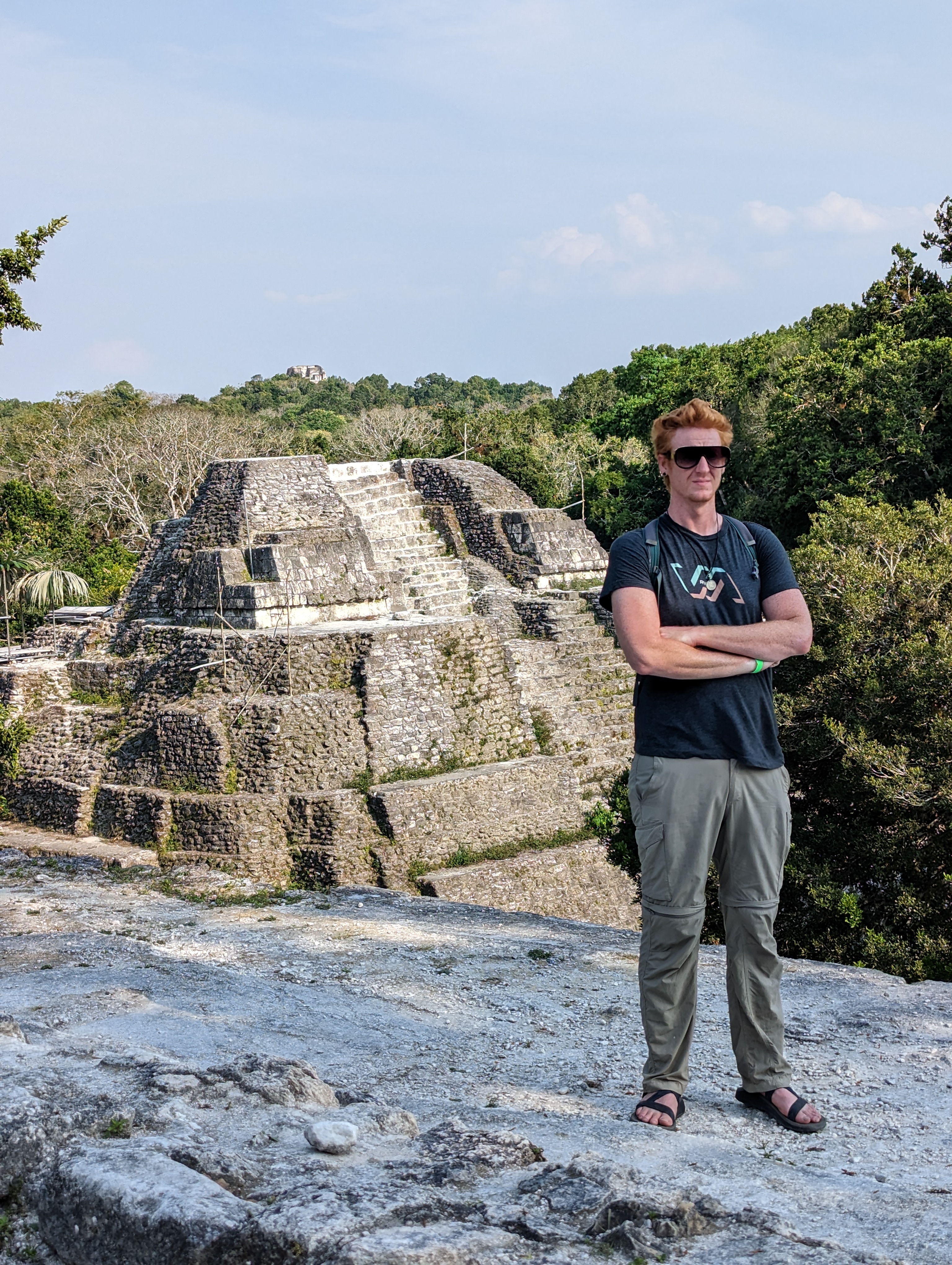
The Maya were never really one people. More a culture group, each city was independent and often in fierce rivalry with its neighbors. Imagine a slightly more diverse version of ancient Greece.16 Among these various cities, Tikal was one of the greatest. From its founding in 900 BCE until its records cease in 869 CE, Tikal’s power waxed and waned, but at its height, it was almost certainly one of the most powerful Mayan cities in existence. Today its remains stand as one of the most amazing archaeological marvels on planet Earth.

We wake up at 4am to catch an early shuttle in hopes both of catching wildlife still active and of avoiding heat so we can remain active. We have elected for a guided tour this time, though I will slightly regret this decision. The guide was wonderful and kind, but he is catering to a large group of tourists who know basically nothing about Tikal, not a weird American who may or may not have read three different books about the history and culture of the ancient Maya. But it really doesn’t matter, because I am there to see the ruins themselves, and even after Yaxha they still exceed my expectations.17 The first pyramid we see is taller even than the tallest from Yaxha. I stand under its shadow and gaze in awe, barely registering that the guide is speaking. Shortly there after we enter the Great Plaza, and my heart is full. There are places on Earth where all you can do is stand and try and absorb the images your eyes are sending to your brain, images your brain is certain must be a trick. Many, perhaps most, are natural, demonstrating Nature’s continued superiority to man. But some are man made. The Colosseum of Rome, The Temples of Angkor, Teotihuacan. The Great Plaza of Tikal is one such place. Completely surrounded by structures of huge proportion and obvious significance. Here surely, if there are Gods above, men communed with them. In another part of the park we ascend to the top of great astronomical structure, where with the typical ancient Mayan talent for spectacle, three medium size pyramids sit West of a much larger pyramid, this arrangement designed for the tracking of solstices and equinoxes. We climb the great Temple IV, famous for its appearance in Star Wars, but for me now famous for its spectacular view above the forests of Tikal. And Tikal is surrounded on all sides by tropical forests. Spider and howler monkeys hop between trees, birds of every type sing and fly about, tarantulas hide in holes, water dragons scurry across paths, and coati search for food both natural and nestle made. By the time of departure we have seen only a small portion of what Tikal has to offer, though the exhaustion from 6 hours of walking and heat now reaching 100 leave us with little choice but to retire.

We return to the hostel and nap. Then have a decent lunch at a cafe with a good view of the lake and a friendly cat. That night we have another parting of ways party, this time with C* and R* from the Netherlands. They are continuing North to Belize, while we have more stops ahead in Guatemala. The shot coupons make an appearance, as does the beer pong table. After many drinks and some light bar top dancing, we retire for the night. The next day we have a day of rest and do absolutely nothing of interest except eat some excellent Mexican food from a metal shack. Next stop, Rio Dulce in search of Manatees.
1This is as good a place as any to mention that Mayan is not a language, but rather a language family. Mayan languages are related to each other but are not mutually intelligible. In the same way French and Spanish and Italian are related but not the same.
2A kind of cheap accommodation that usually sits halfway between a hostel and a hotel, though with a wide degree of variance.
3Adding nationalities to these to avoid name confusion. Fortunately I’m sure there is only one person traveling from Denmark with the initial G
4This is a very reasonable fear
5Huxley, Aldous, Beyond the Mexique Bay, 1934
6Except for perhaps San Pedro La Laguna which is dominated by its backpacker culture. This is of course where we stayed.
7Here meaning we woke up late and so it was our first meal but it was lunch time. Not to be confused with brunch, a thoroughly white America creation wherein you are charged $40 for eggs and cheese in a tortilla but it’s a good deal because the mimosa is only $4
8Most likely Kaqchikel based on which town they traveled to, though possibly Tz’utujil, the lake’s other major language.
9Using bro speak to try and attract a different less intellectual audience.
10La Nariz del Indio. I’m not going to wade too deep into this, it’s the only name for the peak, but also my general sense is in Central and South America people of indigenous descent are way more comfortable, and indeed are often proud, to be called Indians (Indios) and refer to themselves as such.
11Really throughout the non Western world. It reminded of a Nicaragua market I visited, but also one I visited in Malaysia, one in Vietnam, one in Panama, etc.
12Honestly I think I could spend a year in Europe just cashing in on “if you’re ever in town”s if I wanted to
13Which is hard, because when you are a 6’3” red headed very pale person in Guatemala you are already pretty close to the maximum a person can stand out.
14They were not.
15She has to do this constantly and is always sweet about it but it is greatly appreciated by me because backpacking is meant for short people.
16If you don’t know what Ancient Greece was like picture a slightly less diverse ancient Mayan world
17 Plus I have Megan, who here again solidifies her place as ultimate travel companion by listening to me lecture at length about everything I know without a complaint and also with a smile.
 Slackerz Guide