If you make the decision to become a backpacker, sooner or later you are going to have an 8 hour or more layover, and sooner or later you are going to sleep in an airport. Travel backpacking at its core is about saving money on the edges in order to have the money to enjoy what matters. What matters is being in a foreign land; seeing, eating, experiencing things you can’t at home. So you stay in hostels instead of hotels because it’s cheaper and hotels are basically the same everywhere.1 You drink cheap local beer instead of import or craft2 And you take flights with long, often multiple layovers instead of direct.3 And when you have an 8 plus hour layover, one that often follows an uncomfortable flight, the best way to pass the time is to sleep.
Airports handle sleeping very differently. Some have literal beds you can rent by the hour, Tokyo and Bogota had these. Some just look the other way, again Tokyo and most US Airports. Some don’t forbid it but make it nearly impossible, chiefly by making sure there are no seats not separated by those accursed arm rests. Manila was this way. Some don’t allow it, such as Mexico City as evidenced by several firm kicks I received on a 14 hour layover there. But the ingenious traveler will find a way.
We landed in the Bogota airport around noon and settled in for our 10 hour layover. First order of business for most people is to locate their gate, but when your layover is this long your gate is almost never posted yet. Instead we walk the airport, making note of coffee shops, restaurants, outlets, and seats not separated by arm rests. Normally bar spotting is part of this, but one of the main things they tell you about preparing for altitude is to avoid alcohol until you are acclimated.4 After our reconnaissance we settle on pizza for lunch, its hard to mess up and airports are a bad place to sample local food.5 Then it’s off to the closest power outlets with a coffee stop along the way. And it’s here that the first inklings of Altitude set in. Bogota is nowhere near as high as La Paz, but is significantly higher than any major city in the US, and over 1000 meters higher than any place we where in Guatemala. For us it takes the form of extreme sleepiness, no doubt aided by the fact that we have been up since 5:30 in the morning. I fight the tiredness with copious amounts of coffee, but Megan caves and finds a group of seats to lay down while we charge electronics. There we remain until our flight.
Bolivia has a very good reputation on the backpacker trail. It is cheap, filled with unique and beautiful sights, has a gentle cadence to its Spanish that is easier to understand than neighboring countries.6 It is a place where you don’t have to haggle over taxis or constantly fear being ripped off. It is also is one of the few Latin American countries that in recent years has taken a stand against US interests in the region. Perhaps related to this, it is one of the few countries that puts US tourists in a lower level than Europeans. And that is what turns this journey from long to grueling.
The normal process for visiting a country as an American tourist goes like this: you land, you wait in line, you answer a few questions, you get your passport stamped, you are done. This is what makes countries like Vietnam stand out so much, they require a visa and it is an ordeal. But it is an ordeal for everyone. Bolivia has the normal visiting process, but only for zone 1 countries. And Bolivia has decided that the US is not a zone 1 country. Bolivia has decided that US citizens need to pay, and they need to be grilled. We were not prepared.

Our flight lands in El Alto International Airport at 2 in the morning and we proceed to customs. As we wait and wind our way through the line we are repeatedly questioned by Interpol about someone they are looking for. Perhaps this presence is what has everyone on their most by the book behavior, but whatever the reason I know we are perhaps in trouble when I see the envelope of documents that every other zone 2 traveler has with them. As we wait in line our Covid and yellow fever vaccines are checked and we are sorted into our appropriate groups. Then the fun really starts. Immediately in front of us, currently attempting to gain entrance are a group of Chinese tourists who speak zero Spanish and zero English. So they pass a cell phone back and forth, the immigration officer asking questions in Spanish, which the phones translates to Chinese, and then the tourists answer back in reverse. It is painstakingly slow. In order to attempt to speed up the process, an additional official is going back in forth in line trying to make sure everyone has all of their documents in order, unfortunately he refuses to speak to us in Spanish and his English isn’t the best and just adds to the confusion.7 We are at one point threatened with refusal of entry after I try to explain that our plan is to cross by land into Peru near Lake Titicaca, but this does not come with proof of exit. Luckily I am prepared with a fake airline departure ticket from La Paz purchased for just this scenario. In the end I believe the frustration from the previous Chinese tourists aided our entrance as the officer actually handling passports was no doubt ready to go home,8 he was more than willing to sell us the tourist visa and settle for taking pictures with his phone of our hotel and flight information off my phone. So finally, at around 4AM we gathered our bags and headed to the airport, $320 poorer but happy to have been allowed to enter.
We finally arrived at the hotel where we would spend the next three days sleeping at 4:45, though we did not get in until after 5 as the desk guy was who knows where while we banged on the hotel door and rang the doorbell mercilessly. After 23 straight hours awake someone was letting us in the hotel. When I say we spent the next three days sleeping it is barely an exaggeration. Altitude sickness affects everyone differently, but it most commonly presents as a hangover. So it was for us, with an extra dose of total exhaustion.9 The first day we slept for 10 hours, waking up at 3 in the afternoon to order pizza delivery from a place that was a 3 minute walk from the hotel, then back to sleep. The next two days would consist of 2 minute walks to the closest cafe to the hotel and longer 5 to 7 minute trips to dinner. Both would leave us completey out of breath. In fact merely walking up the single flight of stairs to our room was enough to make me collapse on the bed for 15 minutes. Oxygen it turns out is very important.
After our three days of luxury in a hotel it was time to return to proper backpacking. So we headed for the Adventure Brew Hostel, and a lesson in misery. To be fair to Adventure Brew it had several positives. The bar sold craft beer made by the owner for about the same price as local cheap beers, it was very convenient for accessing the bus station, and there were a lot of blankets. The blankets were a necessity however, as Adventure Brew was hands down the coldest hostel I have every stayed in. Set in what must be La Paz’s oldest building, in a city that already has a deep allergy to heat both natural and artificial, every night was an exercise in how fast one can change clothes and climb in a bed before the cold reaches your bones, pushed there by an omnipresent draft that came from everywhere and nowhere in particular. In the morning you woke up between 6 and 6:30AM depending on when the trashs truck came by which had, I kid you not, a song they played similar to an ice cream van. After your unusually whimsical alarm drove off you spent at minimum two hours trying to convince yourself to get out of bed and into the cold. Free breakfast ended at 8 and trying to make it was an errand fit only for Sisyphus.
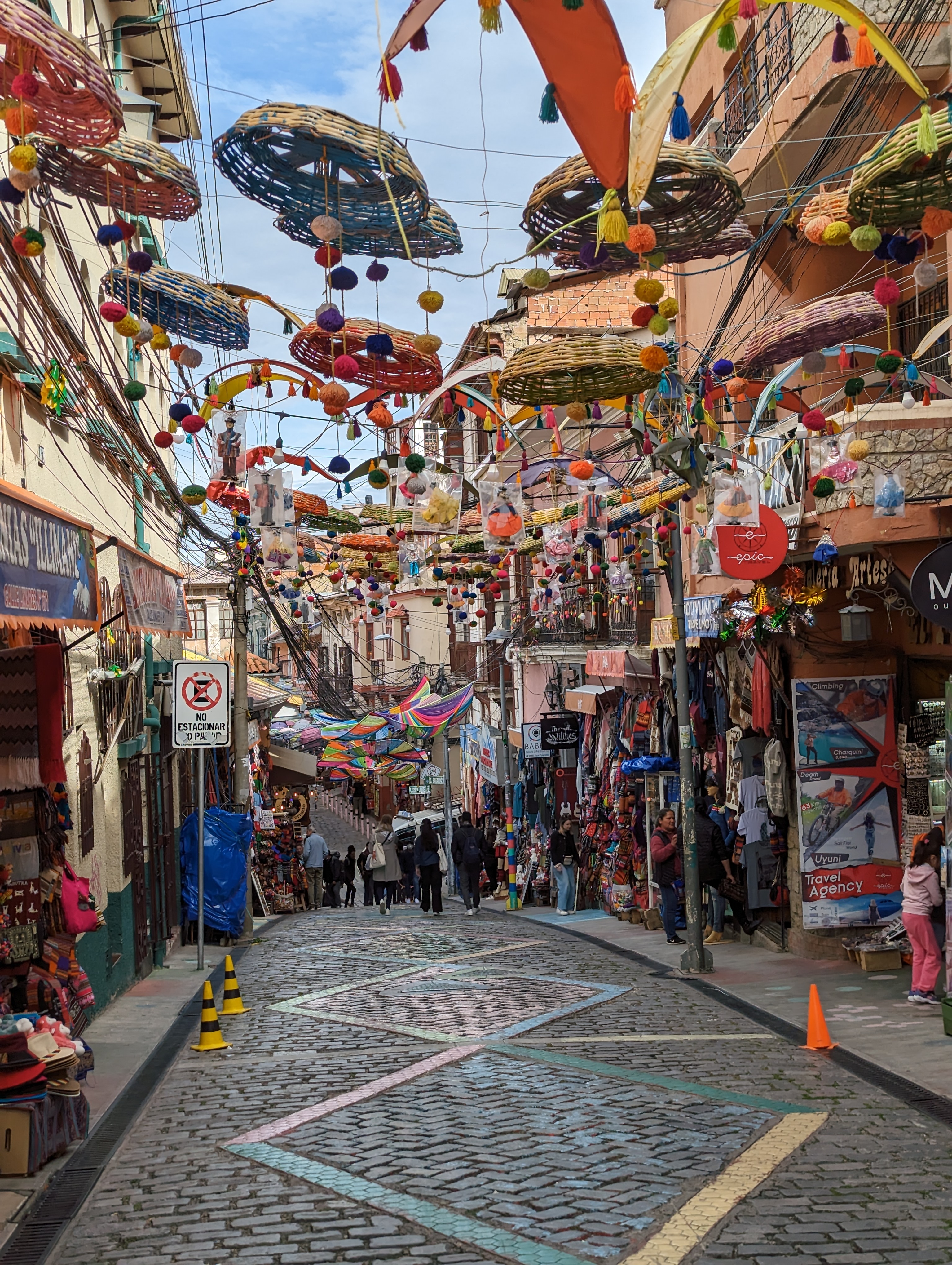
La Paz however is not without its charms. The streets are alive with passersby, street performers, kids in the latest fashion, Cholas in traditional costume, and people dressed in zebra costumes directing traffic.10 Every corner has someone grilling chorizo or salchipapas for consumption. And all of this occurs in a city with hills and stairs that put San Francisco’s to shame. We spend several days getting to know the city, which after about 5 days finally starts to warm when the unseasonable rains finally give way.11 We of course make a pilgrimage to see Megan’s sisterhood in the Witches Market, where you can buy everything from alpaca wool sweaters and stone jewelry to dried lama fetuses, love potions, and various herbs for blessing your new skyscraper. Seriously. We visit 400 year old stone churches where everything is trimmed in gold, art museums housed in colonial palaces, and a couple of leafy plazas where locals eat ice cream and feed pigeons. The highlight of our time was a day spend riding the telefericos, La Paz’s ingenious answer to public transit. A series of what are essentially funiculars that criss cross the city with multiple lines and places to change lines reminiscent of nothing if not a subway system in the sky. We took the purple line to El Alto, La Paz’s more populous and even higher in elevation suburb to appreciate the beauty of the city.
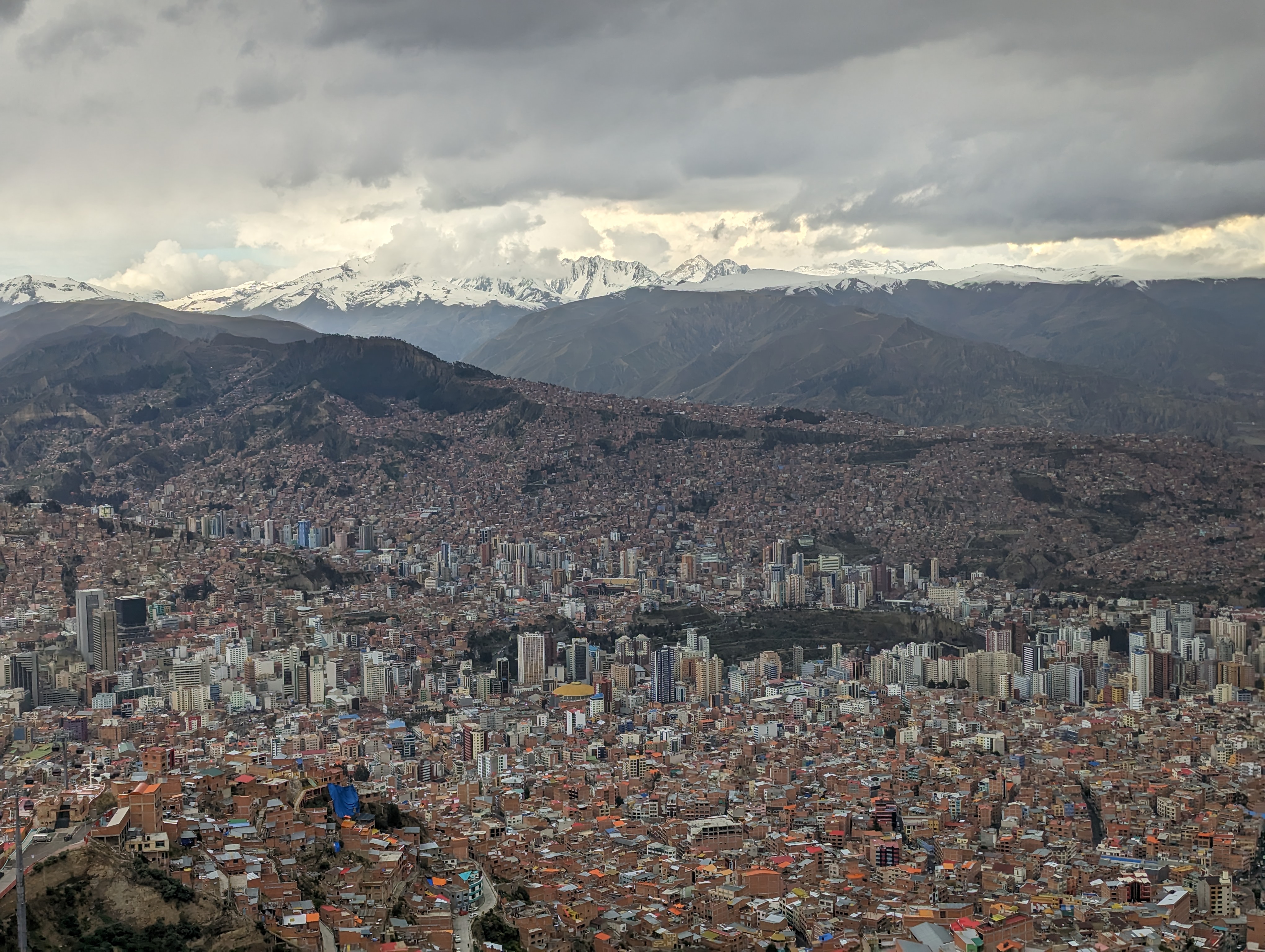
I really enjoyed La Paz. Yes the cold hostel was a daily struggle, as were the unavoidable lung busting hills you had to traverse to reach anywhere in the city. But it has a charm. It is not a city for tourists. It is place where people live and work and play. It is city where the local Aymara people are not afraid to block road access to the city to demonstrate their displeasure with a proposed new law. It is city built in the valley between mountains, where the altitude can vary by as much as 800 meters between different parts of the city, and the temperature can vary by as much as 10 degrees with the altitude. It is a dense city, with streets filled with more people than a city twice its size would have in the US.12 It has a hip district filled coffee shops and vegetarian restaurants, a business district filled with skyscrapers, and in between unending winding streets where people sell their wares beneath blue tarps in the streets. It is city that really loves dogs, and really likes dressing them up.13 And at all times, at all hours, it is a safe city. Assuming you don’t collapse from lack of oxygen.
After about 7 total days we departed La Paz by night bus for Sucre. A journey that provided all the usual pleasures of night bus travel: a bus driver with a dangerous disregard for safe speeds, winding roads designed to make sure you spend some time on each side as you try to sleep, unscheduled stops so someone can board the bus and try and sell you fruit or nuts, and of course someone playing music from their phone at full volume without headphones. Restful night buses are not.
Sucre fortunately was made for the weary traveler. A bright and sunny 75 degrees every day, comparatively flat,14 and gorgeous. Sucre, as everyone will tell you, is the capital of Bolivia. It is an old city, founded in the 1500s, and has meticulously maintained its colonial architecture, going so far as to offer a tax break to those who keep their businesses and homes painted white. It sits on a classic Spanish grid system, with the provincial feeling Plaza de 26 de Mayo at its center, surrounded by old cathedrals, government palaces, and the home of the first congress and constitution. It is a place that can only truly be appreciated on foot, an aimless meander constantly revealing a new plaza, a new cafe, and another imposing church facade. What it never reveals is a Starbucks, McDonald’s, or 7/11, a welcome deviation from the similarly colonial but vastly more commercialized Antigua, Guatemala.15 It is also the best place in Bolivia to take Spanish lessons.

As I have stated before a major goal of mine was to gain a conversational ability in Spanish on this trip, and in Sucre we settled down for two weeks to jump start that goal. We settled into a bit of routine in our time there, coffee and Spanish practice in the morning, followed by lunch and maybe a museum before heading to two hours of Spanish class, and then somewhere for dinner and drinks. It was pleasant, warm, cheap, and necessary.
It is a nearly a given that at some point in a long travel you are going to have to just camp out somewhere at some point. The stress and exhaustion of moving constantly, constantly trying to figure out where you are going next, how you are getting there, where you are staying, and what you are doing when you get there really starts to push you into a wall around 2 months. Sometimes you can hold out for 3, especially if that is when you plan to end your trip.16 But eventually you have to stop moving and recharge. And Sucre is the perfect place to recharge.
Our Spanish teacher, Silvia, is a wonderful person. Each day she works around our schedule, depending on what museum or walking tour we have scheduled for the day. We spend the first hour going over basics for Megan and as a refresher for me, then hour two she spends talking to me. We discuss Bolivian and US politics, places we have traveled, the best places to eat in town, her time spent in the student protests, the US healthcare system,17 Evo Morales,18 and the fact that no one does cocaine in Bolivia despite that fact that it is grown there. She also brings everyone a pie for my birthday. Along the way she corrects my Spanish and assigns me homework, and I love every second. I was born to be a student.
In between coffee and Spanish school we see the sights of Sucre. On day two we join a walking tour to get the lay of the city. Our guide, a university professor and avid anti governmental activist, takes us through the highlights of the city. Stops include a cafe at the top of five story bell tower, a miniature model of the Eiffel Tower designed by Eiffel himself for a local noble who loved Europe but loved his native wife more, and a local bar where we try a local corn based alcohol sometimes fermented with human spit called chicha. Along the way he tells us all about Bolivian history and culture, interspersed with rants against Evo Morales.
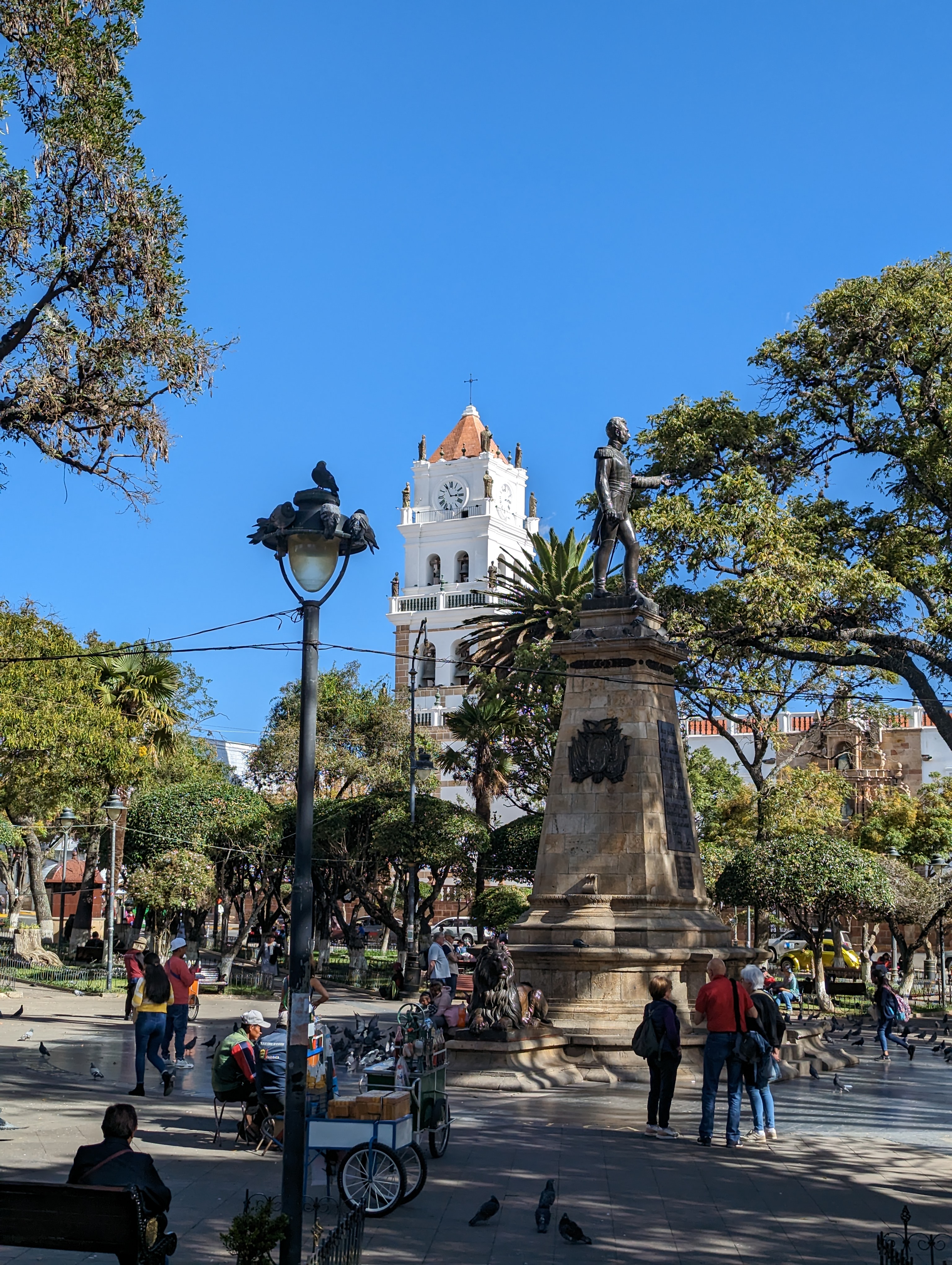
On other days we toured various Cathedrals filled with colonial art and beautiful altars, one trimmed in enough gold to make a conquistador blush, if he hadn’t been the one to loot that gold from the locals. We also visit the Casa de la Libertad, the place where the first constitution was ratified and where we receive a more official version of Sucre’s history from a truly great guide. Of course we stuck around a few days extra to attend a chocolate festival where we tried bonbons, churros with a chocolate core, brownies, pies, and chocolate covered fruit.
We also eat well, better than we probably should. I have the best steak of my life at one French restaurant and one Italian restaurant warrants several repeat visits. This is also where I discover Pique Macho, a godsend of a plate filled with sausage, chicken, steak, frites, peppers, tomatos, onions, all in a spicy gravy like sauce. I had it three times. For my birthday we go in search of a good cheeseburger, an only semi-successful adventure that does result in several rounds of a coca based liquor. I swear we thought she said coconut. We have better luck at Goblin bar, a smoke filled dive bar with sharpie covered walls that serves three beers: gold, red, and brown for dirt cheap and has no food. Basically my favorite bar of the trip.
On our last day in Sucre we take a taxi a half hour out of town to visit Parque Cretacio, home to one of the largest collection of dinosaur footprints in the world. We get dropped off and make a 15 minute uphill climb to the park entrance just in time to catch the only tour that actually takes you down to the footprints. After learning the origin of the footprints and how they were pushed up into their vertical position by the same forces that created the Andes we don hard hats and descend into the artificial valley made by a concrete production company. And there we come within a few feet of the massive tracks, left behind by creatures to fantastic for fiction. After viewing the prints we spend time walking among the several full size models in the park before departing.
Overall Sucre was everything we needed it to be. The warm weather recharged our batteries, the routine gave us a temporary normalcy. And the beauty of the city, the friendliness of everyone we met, and the phenomenal food secured it as one of the best stops of our trip. A good thing too, as we faced down another night bus, this time to Uyuni and one of the single most awesome natural sights I have ever laid eyes on.
1I actually think hostels provide a lot benefits beyond just costs that hotels do not. Hostels are far more likely to clue you into delicious local food as opposed to overpriced western imitation food. They are often run by families (especially in Latin America) who will absolutely treat you like their own child when you are sick. And they are much more social places than hotels, not even the liveliest hotel bar compares to the common area of a good hostel for meeting fellow travelers.
2Basically every craft brewery outside of Europe and North America is owned by US Expats making mediocre versions of the same six styles anyways. It’s just not a great use of money anyways.
3Some examples with layover lengths in parenthesis: OKC to Chicago (3hr) to London, CN (4hr) to Toronto (8hr) to London, UK. OKC to LA (8hr) to Tokyo (12 hour but with 8hr train ride to a DIFFERENT airport) to Manila. Phnom Penh to Manilla (16hr) to San Francisco (5hr) to Houston (3hr) to OKC
4No matter what situation you find yourself preparing for avoiding alcohol is part of the advice. It really is amazing how bad alcohol is for you.
5Though you can make people from Chicago hilariously mad by telling them don’t like deep dish pizza and then telling them you tried it at the airport
6I imagine this is at least partially because Spanish is a second language to a large portion of the population. Bolivia is home to around 38 native languages and many of them, such as Quechua and Aymara, count their speakers in the hundreds of thousands.
7At one point he asks an Israeli couple to translate for him, but they spoke significantly less Spanish than me.
8It was well after 3AM at this point and we were the last plane of the night
9Altitude sickness is rarely dangerous, though my research did lead me to the knowledge that La Paz is at high enough altitude for HAPE and HACE, two potentially life threatening altitude conditions, to develop. So I carried that fear around for all three days as well.
10I am not making this up. It’s some kind of public safety program. It’s bizarre but kind of joyful.
11Warming in this scenario means a high of 60 and a low of 30
12The city population is around 800,000. Compare that to OKCs 650,000 and its absolutely dead at all times streets.
13So many dogs in sweaters. Seriously I thought this was a white people thing but the people of La Paz put us to shame.
14Not like OKC flat, but compared to La Paz it might as well have been Kansas
15Bolivia as a whole is nearly devoid of American chains. Coke is still ubiquitous, but otherwise I think in our entire 6 weeks here we saw one burger king.
16Trips tend to be in three month increments and I don’t know why. Our 5 month trip is actually a strange length for backpackers.
17I know you all think I’m a lost cost socialist hippie but you really don’t fully grasp how bad our healthcare system is until you explain to basically anyone who lives in another country.
18Not the socialist hero I thought.
 Slackerz Guide