When planning this trip, there were of course some major things we knew we absolutely wanted to see no matter what. Tikal and Lago de Atitlan in Guatemala. The Salar de Uyuni and Lago Titicaca in Bolivia. Machu Picchu and Lima1 in Peru. There were other things however that were less geographically specific. We wanted to spend time on the beach for example. But there was no specific beach we were looking forward to. Beaches are all different, but they are also all the same if your goal is merely to touch water and drink margaritas. There are beaches in El Salvador, Guatemala, Peru, everywhere we were going except Bolivia.2 So it was not necessary to pick a specific beach stop, we could just let the trip develop and when a beach fit our travels we would add it in. Hiking, other than the Inca trail, was also an as it comes up activity. There was one other destination, one very important destination, that also had an open ended location. The Amazon Rainforest.
No doubt the first country to come to mind when I say the Amazon is Brazil3 And it is true the majorities of the Amazon Rainforest and River Basin lie in Brazil. But parts of it also lie in Suriname, Guyana, Colombia, Ecuador, Peru, Bolivia, Paraguay, and France.4 So while the best way to see the Amazon River is in Brazil, the Rainforest can be seen from many places. We decided to see it in Bolivia, because it was the cheapest.
Our 45 minute flight from La Paz lands in Rurrenbaque at 8:45 in the morning. The Rurrenabaque airport is a work in progress. It is served by three arrivals and three departures a week. The same plane is used and it leaves Rurrenabaque approximately 30 minutes after it arrives most Mondays, Wednesdays, and Fridays. I say most because it is subject to frequent cancellations. When we deboard we walk past the still under construction waffle house sized main terminal and head for a nine foot tall concrete rectangle about the size of a moderate hotel room, the bathrooms located in a smaller detached bunker. After a few minutes a small tractor towing a wooden cart with our bags in it arrives, we gather our luggage and hop in our first tuk tuk of Bolivia into town.
Rurrenabaque is not a large town. There are a half dozen restaurants, less than half of those decent. There are 20 tour companies, 3 ATMs, and other than the rainforest itself, no sights. But it is warm, hot even. And our hostel has a pool. So we have booked extra days in order to enjoy some weather in said pool in addition to journeys into the rainforest. Our hostel, El Curichal, is also a social one, and we make numerous friends while hanging around the pool and drinking in the bar. One, L from Germany, is soon to become a temporary traveling partner.
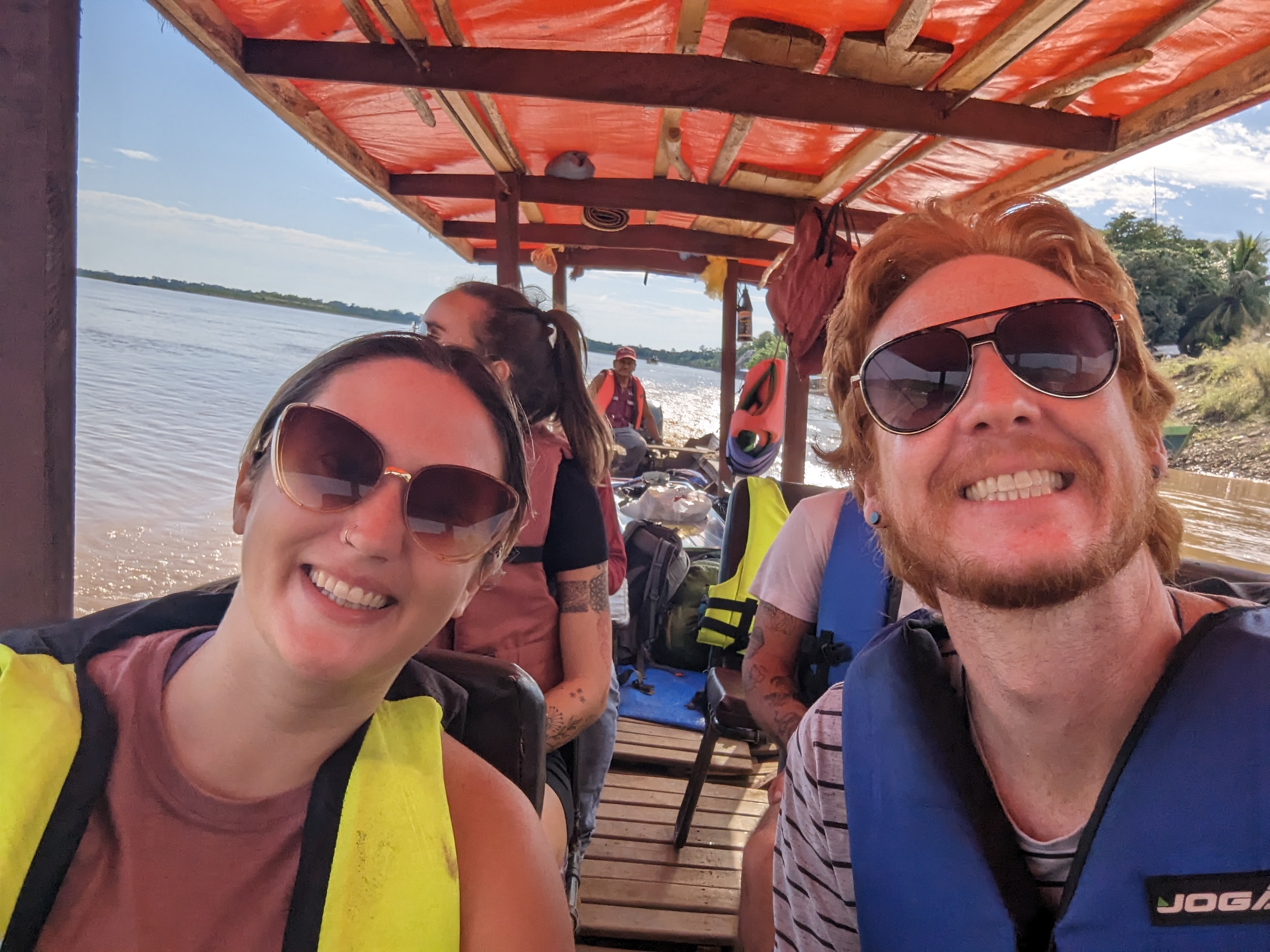
After some research we decide on Mashaquipe tours due to their reputation for sustainability and ethical practices, very nice lodge, and proximity to our hostel.5 We decide on four days total, two in the Rainforest and two in the Pampas. We book for two days out, giving ourselves a day by the pool, and the following morning we rendezvous at the office at 8:30 in the morning. There we meet our companions for the trip, a very energetic young German couple, and we board a boat to journey into the jungle. We make one brief stop to crush our own sugar cane into a delicious drink we enjoy with lime. Then it is 2 hours further up river to our destination, the Mashiquipe Lodge within the Parque Nacional Madidi, a 19,000 Square kilometer nature reserve covering Andean slopes and Amazon river basin. The lodge is basic but not uncomfortable, there is no cell or wifi and electricity only for a few hours in the morning and evening, but the beds are nice and as we learn at that days lunch, the food is phenomenal. After settling in and having lunch, we make our first 3 hour sojourn into the forest. There are birds and insects a plenty, though the thick vegetation makes spotting much else very difficult. Our guide, Nilo, instructs us on which plants to use to remove burrowing flies6 and warns us to watch where we put our hands lest we suffer the bite of a bullet ant, so named for the feeling of pain the bite most resembles. We encounter a few giant trees, too big for even the five of us to encircle, and near one Nilo sits us down to tell us how our old friend Evo Morales opened the park up to mining interests and is further threatening to flood nearly 10% of the park by building a dam.7 I am really starting to have doubts about that guy.

We return to the lodge for an equally amazing dinner and then head out on a night walk. Highlights include several tarantulas, an owl, a caiman, a jaguar footprint, and an absolutely stunning night sky with visible milky way. There is of course also the cat. A cat, named only cat, who lives at the lodge follows us for the entire journey, stopping only to whine at water crossings before finding his was through. Every so often as you strain to see wildlife in the dark distance, he scampers between your legs or calls out from the other side of a creek. It is cute, but also gives me low level stress as I worry about him getting lost or getting eaten by a caiman or taken by an owl. But he seems to make this trek often and we all return to the lodge safe and sound.
The next day after breakfast we set out on a full day tour of the rainforest. We our joined by Fatima the chef, who opts to accompany us and cook our lunch on site rather than send us with packed lunches since we are the only ones in the lodge. The cat also comes at first, though Nilo shoos him off because we have to return in a boat. He says it in such a way that makes me suspect they have tried to bring the cat back in the boat before and it did not go well. We spot Toucans and a dozen other birds, get lessons in how to use soldier ants as stitches, and which plants taste like garlic and which ones can be used as an anesthetic for a sore tooth. We also get to journey deeper into the jungle and see how the vegetation changes as you go deeper. Small bushes and walking trees give way to acai trees and open ground. We stop at a camp for lunch, a grilled chicken in orange sauce with quinoa and rice, then take a nap before continuing. We arrive after about 5 hours hiking at a nesting place of red macaws. Dozens of the beautiful birds fly around us and make their cries. They take turns bringing in material for the nests, working in parental pairs. They provoke awe, and also jealousy of the zoom on Megan’s camera among the rest of the group. After we leave we walk an hour to the river, passing the ruins of an abandoned government project to build a wooden walkway through the rainforest connecting the Macaw nesting grounds to the river. The facilities look quite nice actually, making the projects failure even more baffling. Finally at the river, we change into our bathing suits and help Nilo build a traditional raft out of logs from the forest, and then float it down the river back to the lodge.
The next day we transit to the pampas. We leave the lodge and return to Rurrenabaque by boat where we transfer to a van and begin the three hour journey to the wetlands. We stop three times, twice for sloths spotted along the road and once so our companions could pee, also along the road. We reach another river and tswitch back to a boat, and then the Pampas shows its worth. The Pampas is part of the Amazon basin but it isn’t rainforest. Rather is is a collection of open wetlands crisscrossed by rivers and streams. Because of its comparative lack of vegetation, spotting animals is much easier. Within the first 30 minutes we have seen just as many birds as all our time in the jungle. We also spot numerous caimans basking in the sun, and are frequently flanked by pink river dolphins, coming up to breathe and announce their presence before disappearing back under water just before you snap your picture. We journey around an hour and reach the Pampas lodge, a much busier place that also features 24/7 electricity. We drop our stuff in our room and go for lunch. With far more people in the lodge lunch is served buffet style but is equally delicious. Then we head back out on the river. We see dozens more caimans, snake birds, ibises, 200 Hoatzins,8 more dolphins, three types of monkeys that show no fear of the boat, and one coati. The boat is a little more quiet as one of our two companions, C, is not feeling well. As night settles we bust out our headlamps to spot caimans, including a group of six little ones no more than a few weeks old. Back at the lodge we have dinner and Megan and I are offered a choice for our final day between anaconda hunting or another day on the river. We opt for the river because the anaconda hunt is not a sure thing and also Megan is quite scared of snakes. Besides we also want to see capybaras.
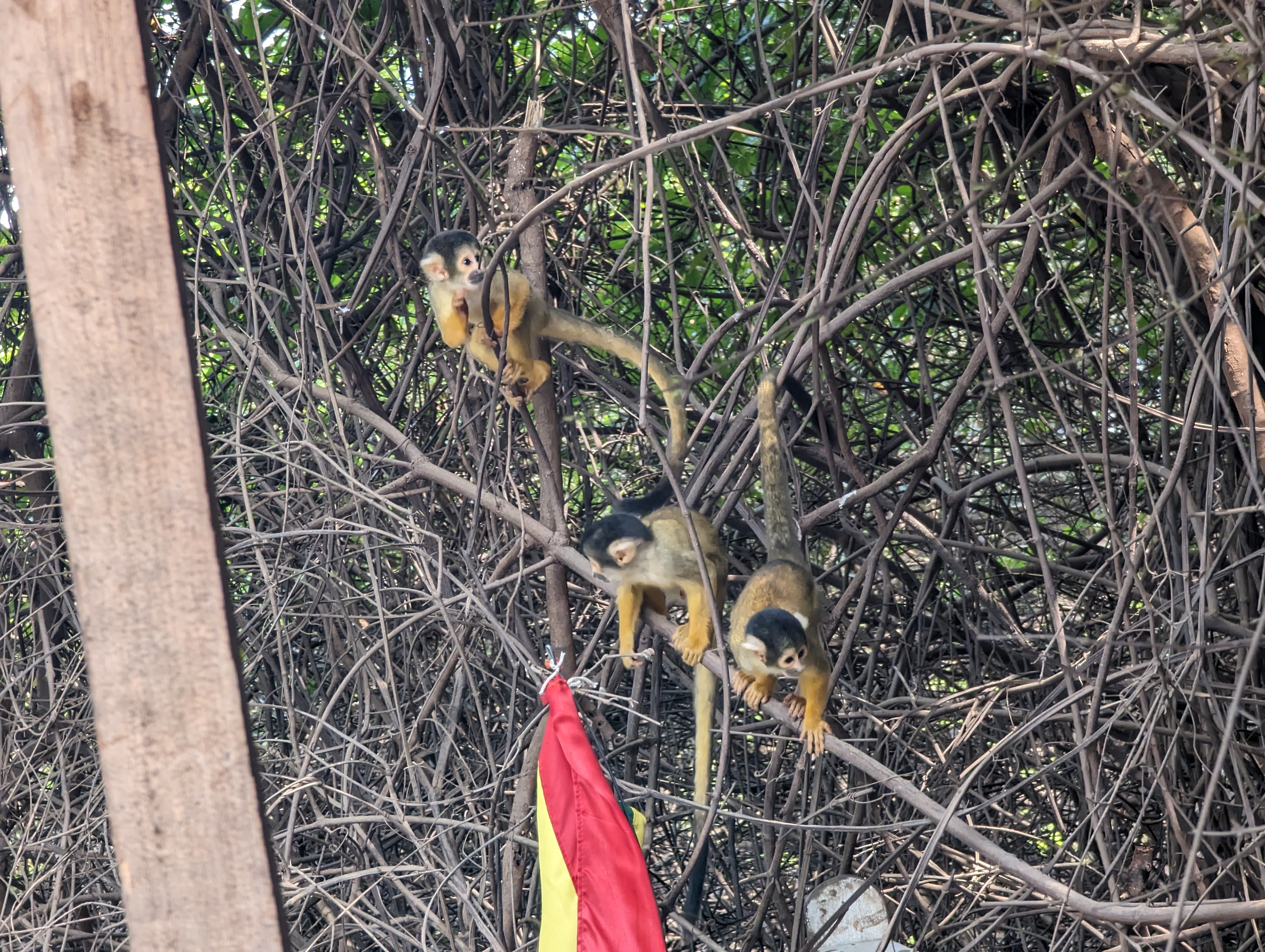
The next morning after breakfast we head out, taking a covered boat because C from Germany is still not feeling well. We spot all the usual suspects and then after about 2 hours we come around the corner and there he is, our capybara, chewing on a leaf, not a care in the world right next to the river. We continue on and spot several more, also going on shore for a closer look at one point. We also get boarded by squirrel monkeys at one point in the journey, a nice experience though carrying a tinge of fear for Megan and I given previous monkey experiences.9 Finally after around four hours we have to head back to the lodge. Other than lunch, Megan and I’s time in the Amazon is over. Though the area has one last surprise for us. As we begin the journey back it begins to pour rain, turning the giant road project underway into a 30 mile stretch of pure mud. We have two separate 30 minute breaks as heavy machinery is brought out to free a vehicle stuck ahead of us. At one point the line of tourist vehicles engage in unintentional synchronized sliding, advancing near completely sideways along the road. Finally after two hours we pass beyond the road construction and can make real progress back to Rurrenabaque.

The rain has two more surprises in store for us. First it brings with it a rare weather phenomenon in which the almost year round warm rainforest drops in temperature down into the low 50s. The town, experiencing this so rarely, is ill prepared. Our hostel has to commandeer blankets, of which we get the last one. The rain also extends our stay, as the Rurrenabaque airport-esque facilities cannot operate in the rain. So we are forced to spend two extra days in a town with little of interest outside of the jungle, stripped temporarily of its two redeeming qualities; warmth and pool. At least we got to eat at the absolutely delicious and surprisingly cheap Luz del Mar. If you visit Rurrenabaque do yourself a favor and eat only here if you can. We also bump into C from Germany, who it turns out has Dengue fever. This unlocks for us a new fear since we are covered in about 3,000 mosquito bites each. But other than itching we never develop any problems.
Two days late we return to Selina in La Paz, meeting up with L from Germany who arrived a day earlier by bus.10 We all rest for another day before booking a tour to go to the ruins of Tiwanaku. A giant pre Incan complex, the Tiwanaku civilization initiated many of the construction and empire building techniques that would later be perfected by the Incas. The site is also very popular with ancient type conspiracy people. Unfortunately for us, either because of this popularity or because of true belief, our guide was one such believer.
Let’s address the aliens stuff for a second. For starters it’s not true, obviously. If you are a believer I’m not going to try and convince you otherwise. There is no point, you won’t listen anyways. Just know that you are wrong. But know also that you, and those of you who entertain or otherwise view these theories as harmless, are engaging in a very old strand of European racism. The thought process, articulated since Europeans first encountered ruins of ancient civilizations outside of Europe, is that obviously these primitive people could not possibly have built such magnificent structures. The only possible explanation is aliens.11 Nevermind that the techniques used to build these sites are impressive but well withing human capabilities. Or we have evidence of how it was done. Or that no one questions how ancient Greeks built the Acropolis or how ancient Romans built the Colosseum. Nope, non white people are inferior so it must have been aliens. It’s racist. Stop being racist.12 Also if you have a sign in your yard that says “science is real” or something along those lines and you believe aliens built Machu Picchu or the Pyramids or whatever please go take your sign down, you have lost your privileges.
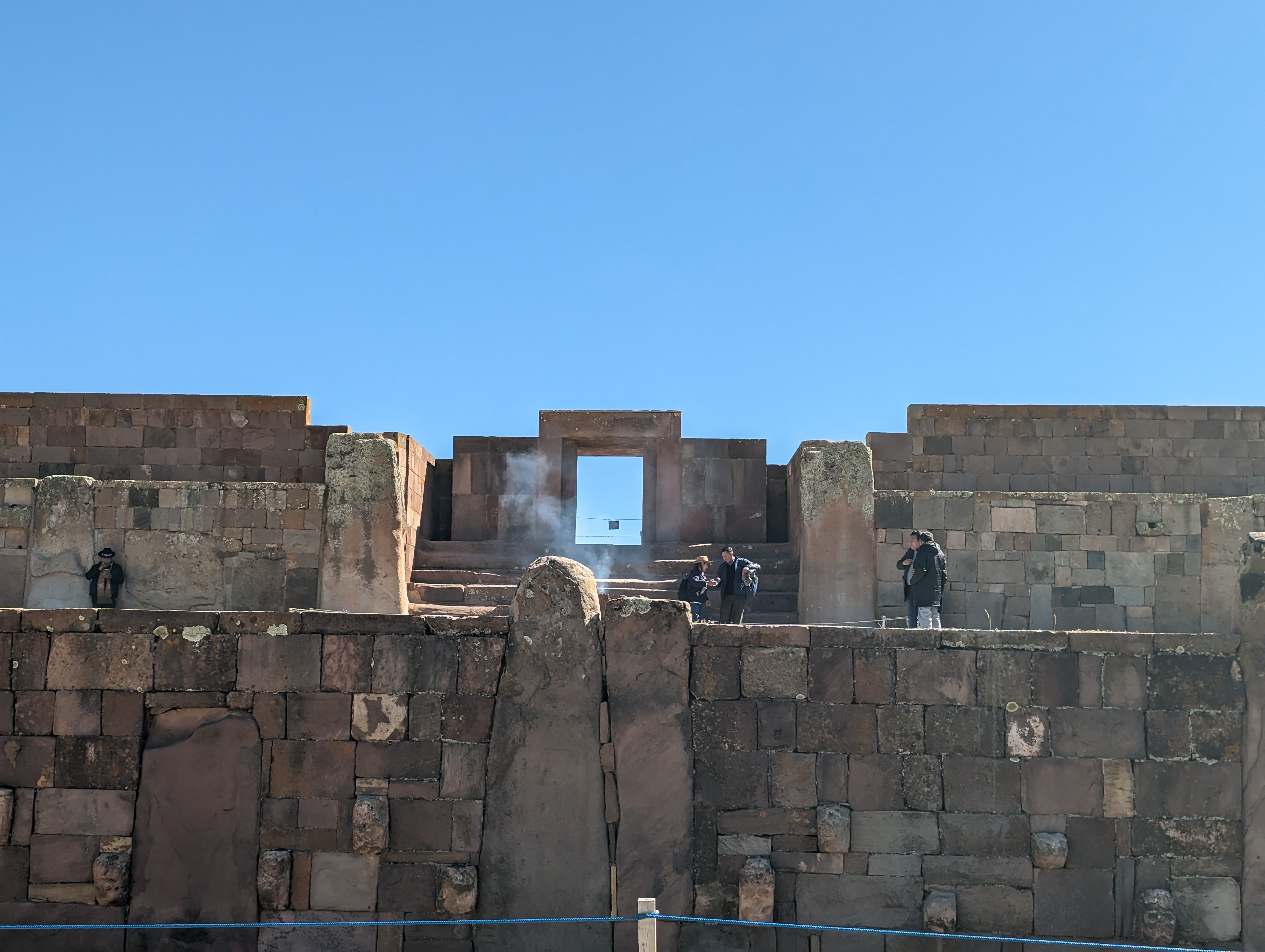
Back to Tiwanaku. We wander the site, venturing further and further away from our tour guide and his prehistoric canals for trading with Egypt and his doorways to other dimensions13 and try to appreciate Tiwanaku on its own merits. It is truly a shame because I would have loved to learn more about the site and the people who inhabited it. How they built these structures and where they mined the stone, what the carvings meant and how they used the sun alignment to predict the seasons. But alas even when our guide touches on these subjects it is impossible to tell what is archaeology and what is from a bad Indiana Jones movie.14 Just before we leave the site we encounter a news crew doing a report on Tiwanaku, maybe because of the proximity of the solstice. Whatever the reason our guide volunteers us to be interviewed. The reporter starts shoving microphones in our faces and asking us questions, never bothering to find out if we speak Spanish. I stumble through an answer about how the ruins are “maravilloso y grandisimo” causing the reporter to accuse me of being “muy nervioso.” Finally free from the clutches of Bolivian TV we go for lunch, and then return to La Paz.
The next morning, Megan, L, and I taxi to the bus station and book tickets to Copacabana. No, not that one, the original one on the shore of Lago Titicaca. The journey takes 4 hours, and at one point involves the bus driving onto a wooden raft to cross a river. Copacabana fails to impress upon arrival, luckily it is not our destination. We head to the harbor and secure passage across the lake to the Isla del Sol. And it is on this boat that the lake really starts to reveal its beauty. Perfectly blue water reflects the sun on the gentlest of waves, reminding us of nothing so much as a Studio Ghibli movie. Islands pop up here and there, and the edges of the lake rise sharply into numerous small mountains, themselves dwarfed from behind by larger snow capped peaks. It is a place of supreme, almost spiritual beauty and is a small wonder why numerous cultures, the Tiwanaku and Inca included, considered it a sacred place.

We have a different kind of religious experience upon arrival on the island. Our hostel is 20 minute entirely uphill walk away and there are no roads and thus no means to reach it other than by foot. The entire island in fact is car free, the only traffic issues caused by mule trains and sheep herders. So we began the walk, carrying the entirety of our possessions, beginning with the Inca Stairs, a climb of around 50 meters straight up.15 Then an additional 100 meters of winding paths finally get us to the hostel where we collapse into the first available chairs. Oh, did I forget to mention the whole island sits at over 3,800 meters elevation? Because it does and we had the expected breathing difficulties that come with that height. We do very little the rest of the day except eat dinner and go to bed at a decent hour. The next day we set out to hike the island. A seven hour loop that allows us to view some of the most stunning scenery of the trip. The lake stretches in all directions, amazingly clear when near the island and maintaining its cartoon blue color. The island slopes down often in terraced form toward the water. Stone paths crisscross it connecting tiny villages. Herds of sheep and llamas graze in the perpetually sloped fields. At the far north end of the island we encounter the Roca Sagrada where the sun was said to have been made by the Incas, as well as mysterious Inca ruin known as the labyrinth that demands we wander its stone walls and passageways for a half hour. Then we start the loop back, passing villages but alarmingly gradually moving down to the lake level. That decrease takes it toll later as the last 2 hours of the hike are entirely uphill and sap all the remaining strength and oxygen we have. We reach the hostel just as night sets and barely have the energy to go to dinner. But we go and we celebrate, or at least reminisce. It is our last full day in Bolivia. The next day we head back to Copacabana and catch a bus to border. Next stop the former capital of Incan Empire, and an item to cross off my bucket list.
1This is primarily about food. Lima is supposed to be one of the great food cities on Earth. We shall see.
2Bolivia used to have access to the ocean but ceded this territory to Chile after the War of the Pacific. They have not really let this go.
3Or the US because capitalism ruins everything.
4Yes I mean French Guiana, but politically French Guiana is just a department of France, just like Paris or Bordeaux. It is part of the EU, uses the Euro, is where the European Union Space Agency launches satellites. This also oddly means that France’s largest land border is with Brazil.
5As in they were literally the closest company and first one we visited. In our defense we had done considerable research in advance.
6As disturbing an insect as it sounds.
7Though he is making noise about returning to power, technically it is his party and successor currently in charge of Bolivia and moving forward with these plans. Also while I’m fairly convinced the greed involved and loss of ever decreasing forest land is not worth the cost, one should always remember it is easy for us in the West to tell people in other countries they should value their natural resources more, but a source of cheap electricity would greatly the improve the lives of many people, especially in a place as poor as Bolivia.
8A medium sized red and blue bird that can only fly about 20 feet and makes a panting noise reminiscent of a dog.
9We were basically attacked by monkeys in Costa Rica thanks to someone further along the path feeding them and then trying to pet a young one.
10We explored this option, and it would have saved a lot of money, but the best experience we had related to us about the bus was from A from Argentina who said it was “f*cking misery for 18 hours”
11Or some ancient lost race of white people. Maybe from Atlantis.
12Seriously, I feel like I have to say this extra loud in present day USA, STOP BEING RACIST.
13Seriously both of these things were mentioned.
14You know which one is the bad one.
15That’s more than a football field for those of you still refusing to learn the metric system.
 Slackerz Guide