You expect some culture shock when you start a trip. You always learn to expect it when you return home, especially after a long trip. Experiencing the little differences between countries is one of the best parts of traveling. I even expected to have some adjustments to make when moving from Central America to South America. But nothing prepared me for the total whiplash of going from seven weeks of relatively tourist free Bolivia to the Mecca of tourism that is Cusco. It was not something I enjoyed.
I’m just going to go ahead and spoil the ending here at the beginning. I did not like Cusco. I, history lover extraordinaire, mansplainer of archaeological sites, reader of 3 different books on the Inca before the trip, did not enjoy Cusco the former capital of the Inca empire. And it’s all your fault.
Of course I enjoyed seeing the Inca architecture where it remained. Even the Spanish cathedrals, despite the crime against humanity they represent sitting as they do over the ruins of that great empire, are beautiful beyond your imagination.1 The museums contain beautiful pieces, the Inca walls inspire awe, and the coffee was pretty good. But Cusco as it exists today, exists for you, and not for me. Because Cusco wants to make sure that tourists feel comfortable, provides them all the comforts of home, and then tries to sell them as much as possible.
I have to contrast Cusco with Bolivia. It’s probably a bit unfair to contrast one city with a whole country, but the shock we felt, the almost discomfort was a direct result of this transition. There really isn’t a city like Cusco in Bolivia, which is of course the point. There isn’t a city like Cusco on Earth, especially when combined with its role of gateway to Machu Picchu. But everything we felt, all of the unpleasantness and petty annoyances, were amplified by our previous experiences in Bolivia. But I digress, this is a narrative blog after all.
We travel, as we all too often do, by night bus. It’s a walking border, meaning we have to get out on the Bolivia side for exit stamps and then walk across the border to the Peru side for entry stamps. Then we board another bus which takes us first to Puno for dinner and then on to Cusco. On the way the bus guide tells us it is the fullest bus she has had in months. It is a quarter full. For those who don’t know a massive wave of extreme and occasionally violent protests swept across Peru for much of the first half of the year centered around the ousting of a popular president, especially with the Indigenous communities of the country. Puno was one of the epicenters of the protests, which at one point were sufficient to shut down Machu Picchu, the country’s great tourism revenue generator. Eventually a truce of sorts was reached, Machu Picchu was reopened and the government promised elections. But the situation remains tense. A small by product was that there were far fewer people crossing into Peru from Bolivia by road. Passing through Puno was at times not even possible. We were also made to understand that tourism in Cusco was still below normal levels. I believe this, ironically, contributed to my dislike.
The issues showed themselves the first day. After arriving at 6 AM and then sleeping on a couch for 2 hours before gracefully being allowed to check in early, we arose to explore the city around 2 in the afternoon. Our hostel was exquisitely located, directly next to Qorikancha and less than an 8 minute walk from the Plaza Mayor of Cusco. Naturally we headed straight for the square, to get our first look at Pachacuti’s city. Within seconds we received our proper welcome as a man thrust a paper in our faces showing all the different tours on offer. Behind him literally yelling over him a woman offered us an “Inca Massage, 20 Soles!” We escaped, but as we circled the square we dodged at least 8 more masseuses, 12 tour operators, 1 aggressive restaurant menu holder for every restaurant we passed, and at least another 10 women offering pictures with llamas. Enjoying the scenery, taking in the cathedrals or the surrounding mountains, simply existing was impossible. Each peddler turned away was replaced by two more. Some simply tried to sell us cigarettes, as if they aren’t readily available in every store or bar in the city. Exhausting doesn’t begin to describe the experience. I felt defeated. Here we were in the city to which we had been striving this whole trip, on the precipice of visiting perhaps the greatest archaeological site on earth, and I was spending my afternoon dodging in person telemarketers. We abandoned the plaza in short order.
As I said so much of this disappointment stemmed from having come from Bolivia. In La Paz you could walk into a shop in the witches market and encounter less overbearing sales people than on the streets of Cusco. No one in Potosi tried to literally toss a llama into my arms so I would have to pay for the experience, something that did happen in Cusco. Not one person in Sucre blocked my path to try and sell me a watercolor painting of the city. And honestly Sucre was a prettier city. Earlier I of course blamed you, dear reader, so let me explain myself. I have of course stereotyped you, but let’s be honest. We both know you are a vacationer. I know it because I haven’t see you on the trail. Haven’t seen the pictures of you hunched over because you threw your back out carrying your 40 pound pack rather than taking a taxi. I know it because you still have bathroom standards rather than being thankful when you don’t have to dip into your personal toilet paper supply. You don’t recognize AC in a vehicle for the luxury that it is. We once had the bus driver leave the emergency roof exit open for air flow and we felt blessed. You old people these days are spoiled. So let me tell you another difference between Bolivia and Cusco. We did not see a single Starbucks, McDonalds, or KFC in our entire time in Bolivia. Cusco had all three occupying some of the oldest most historic buildings in the Plaza Mayor. And it’s all because of you.
Tourists come to Cusco. They come in droves to see the city and visit Machu Picchu, and they expect the comforts of home to be there waiting on them. And I’m not completely immune. Nothing is more of a relief than having a 3 hour wait at a sketchy bus station with a paid toilet with no door and an extra cost for TP and also no food in the station even though you haven’t eaten in 9 hours then finding out there is a McDonalds around the corner. No religion has ever provided a similar sense of salvation. But there is something true, something pure, about having to eat something unfamiliar. Even if it isn’t local food. At least I know how they make burgers in La Paz.2 But in Cusco they have imported Western Culture. And they have gotten too much of it from the US. Maybe at heart that was my problem with Cusco. Unlike everywhere else we traveled this trip, Cusco was filled with people from the US. These tourists, with their comforts of home, are also prime targets for the street vendors of the world. After all what is a five dollar massage or 15 dollar painting to someone who plans on spending $3000 on their 10 day vacation.

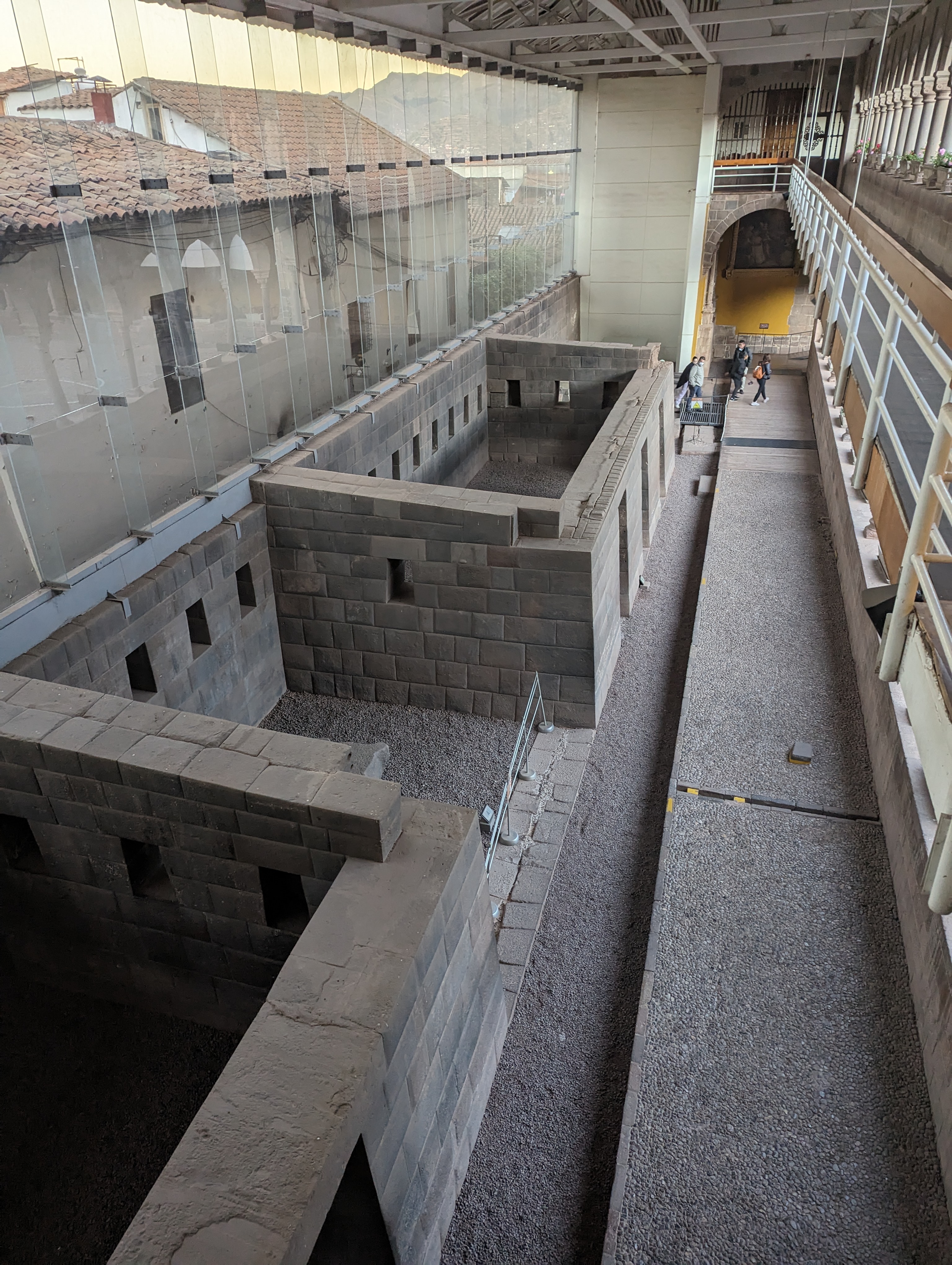
We spent the next 4 days exploring Cusco and dodging venders. We finally visited both of the grand cathedrals in the main square, and watched some of the parades leading up to Inti Raymi from the balcony of one. The Cathedral of Cusco was impressive, it’s entirely gold leaf altar was particularly striking and the second chapel was a colorful and inviting space, even if ABC3 fatigue had begun to set in. We met up with L from Germany again to visit Qorikancha, my personal highlight of the city. The site is under a bit of a rebrand, or a debrand? Qorikancha was the name of the original Inca temple before it was looted of all it held and then mostly destroyed by the Spanish, replaced by the Convento de Santo Domingo. I say mostly because several earthquakes have revealed the genius of Inca architecture when only the original Inca structures were left standing. After the last one the Inca walls and buildings were left uncovered and the site was turned into a tourist attraction. It is the greatest concentration of original stonework in the city proper, although this is not saying as much as it should. Still the Inca structures in the temple are remarkable and even the Spanish parts are impressive. Cusco was a center of Spanish power in the empire and that prestige and resulting wealth shows throughout the city. We also met up with L from Germany in a vain attempt to see the Inti Raymi festival. Despite the best efforts of our driver, the festival was only reachable by an uphill walk no one felt up to. We salvaged a trip to a museum of Pre Colombian artefacts and an Italian dinner, just because I lecture about eating McDonalds doesn’t mean I’m not a hypocrite who eats pizza constantly, it just means I don’t eat McDonalds.4 I coaxed an ill Megan out of bed one day by taking her to a cat cafe, which was as purrfect5 as you think it was.
We of course had another reason for being in Cusco, same as everyone there. Only we weren’t sure how we were going to get there. There are many options for visiting Machu Picchu. You can of course take the train to Machu Picchu Pueblo/Aguas Calientes6 and then the bus up to the ruins, the easiest and fastest option. You can take the famous Inca Trail, a 4 day hike believed to be the original path to the city that is fairly challenging and must be booked months in advance but ends with you walking directly down into Machu Picchu. You can do the only slightly less famous Salkantay Trek, a more difficult 5 day trek that features stunning scenery and can be booked the day before although it doesn’t actually end at Machu Picchu. You can walk the train tracks, a free path that is more beautiful than you would think but involved dodging the train. Or you can do what we did and take the 2 Day Inca Trail. If you didn’t know such a thing existed, well neither did we.
The 2 day Inca Trail is really a one day hike and a one day visit to Machu Picchu. It allowed us to still hike into Machu Picchu directly, without having to hike for four days and book months in advance. We were picked up from our hostel at 3:30 in the morning. After all of our fellow hikers were collected we traveled 2 hours by shuttle to Ollatayambo where we catch the train to Aguas Calientes. On the train we are entertained by play of sorts about an Inca warrior and princess and their forbidden love. It is equal parts awkward and funny and a little endearing, though based on the faces of the performers, it is exclusively awkward for them. About 15 kilometers from town the train stops to drop us off at the start of our trail. Our group is exclusively from the US except for one Indonesian girl who currently lives and works in the US, another vast difference from our experiences in Bolivia. We have a short and fairly easy hike across the river and to our first set of Inca ruins. A small way station with a shrine where offerings were made before setting on to Machu Picchu. From the moment we crossed the bridge we began to see just how beautiful the Sacred Valley was. The Urabamba River, creator of the valley, winds its way around mountains seeming to have purposely chosen its path based on grandeur and majesty rather than direct access to the sea. As we climb ever higher, never straying far from the river, the landscape only grows in spectacle. The combination of the turquoise river, blue sky, green mountains, and occasional stone structures looks both alien and completely natural. Such a perfect image of Earth that it seems artificial. We also find ourselves, through some combination of increased fitness, lower altitude, and perhaps most importantly in the company of fellow USians7, able to keep up with and occasionally lead the pack of hikers. After about 3 hours we reach Winay Wayna, the large ruin that had been looming over us from near the start of the hike. It is almost hard to believe this isn’t the goal, so beautiful and grand are both the ruins and their setting. A source of food and a final major outpost on the trail the ruins feature some preposterously placed terrace farms and buildings that must have been designed around always having the most awesome view of the valley possible. From the ruins we continue are uphill march to lunch and the final Peruvian checkpoint before entering the Machu Picchu Reserve. From here, we hike another few hours along trail that ranges from a little uphill to aggressively uphill. After a set of impossibly steep stairs known as the “Gringo Killers” We catch site of the Sun Gate.

The Sun Gate, or more appropriately Inti Punku, was the final checkpoint on the road from the Inca capital of Cusco to Machu Picchu. Every year on the summer solstice the sun passes directly through the sun gate, though this doesn’t stop tour companies from advertising this phenomenon every other day of the year. It is also the first place from which we were able to see Machu Picchu.
I climb a set of long and steep stairs until I pass through a stone doorway wide enough for only one person. From there I turn the corner and walk to the edge of stone building with no wall on the Eastern edge. And there I look down on the single most amazing, most spiritual, most awesome, most incredible sight I have ever seen. Machu Picchu. The ruins sit on a small plateau between two mountains, at the exact spot where the river Urabamba curves around them. This causes the site to be surrounded on three sides by the steep walls of the Sacred Valley. Behind the citadel on the otherside of the valley rise even larger mountains, put there by ancient gods to hide Machu Picchu until the world was again ready. If anything they revealed it too soon. Joy overcomes me and I weep, joined in both position and weeping by Megan. It is to this place that we have been journeying. It is maybe to this place that I have always been journeying.
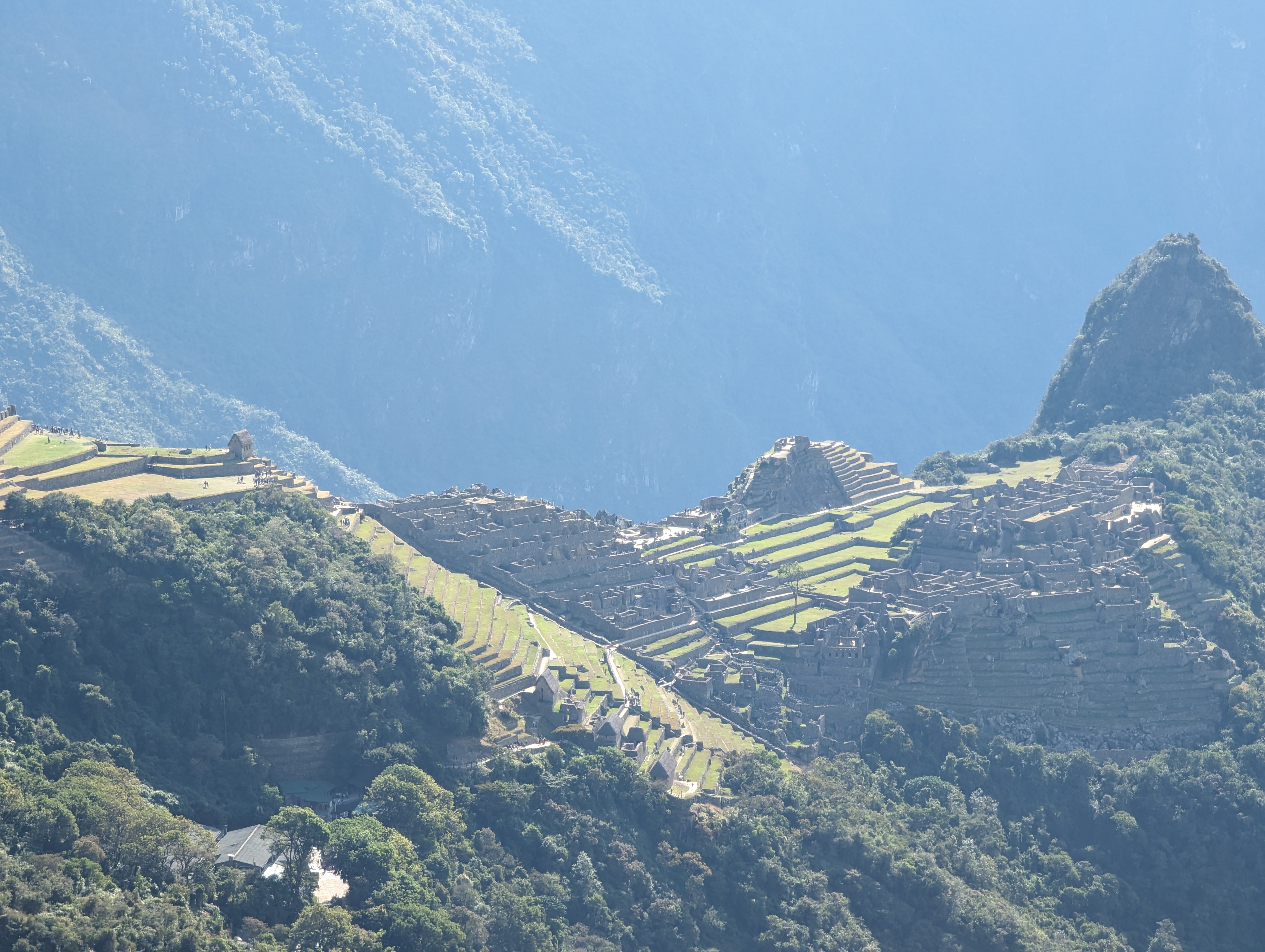
Archaeologists generally agree that Machu Picchu was a winter retreat for the Inca rulers.8 This is accurate but feels a bit like calling Neuschwanstein a fortress or the Taj Mahal a burial chamber. It was built to be fantastic, to inspire a sense of wonder in anyone who saw it. A palace worthy of a God on Earth. As we walk down into the ruins proper I grow both more pensive and more at peace. Let them have their two car garages and 401Ks, cookie cutter suburban homes and steady employment. I have journeyed through time and space, collecting knowledge and expanding my mind. My savings account is memory, in it I store the jewels of the Earth both natural and man made. Angkor Wat and Niagra Falls, The Colosseum and the Amazon Rainforest, Teotihuacan and the mountains of Sa Pa. In this my 36th year I add to my wealth the Temples of Tikal, the Salar de Uyuni, and finally, at long last, Machu Picchu.
We leave the site for the evening to have dinner and sleep. The next day we return for a more extensive tour of the site. We walk among the ruins, the temples where the path of the sun was calculated and mapped, where the Milky Way was charted and studied. The massive stones that form the temples stretch the limits of imagination. To know that something is possible does not diminish the accomplishment. Humans can build anything, but here they actually did. The impossible setting is more amazing from the inside. In every direction I can see a the mountain plunge into the valley and then rise again even higher on the other side. The architectural marvels are just as fascinating. Here is the path carved so that water could irrigate and provide plumbing. Here they built two story homes for extra storage. Here the stone is worn down by a century of kneeling chefs preparing dinner for the Inca. Two giant circular stone excavations were used as laboratories to experiment with breeds of potato and corn. And everywhere great care and ingenuity was taken so that as European buildings tumbled decade after decade from the regions numerous earthquakes the ruins of Machu Picchu still stand.
Finally to my great sadness we are forced to leave. We return to Machu Picchu Pueblo and hunt for campy souvenirs and bad coffee. After lunch we take the train back to Ollytaytambo, mercifully getting to experience the conclusion to forbidden Inca love saga. Back at the hostel we lay down to sleep a peaceful, fulfilled sleep. A great undertaking has been brought to its conclusion. The rest is all epilogue.
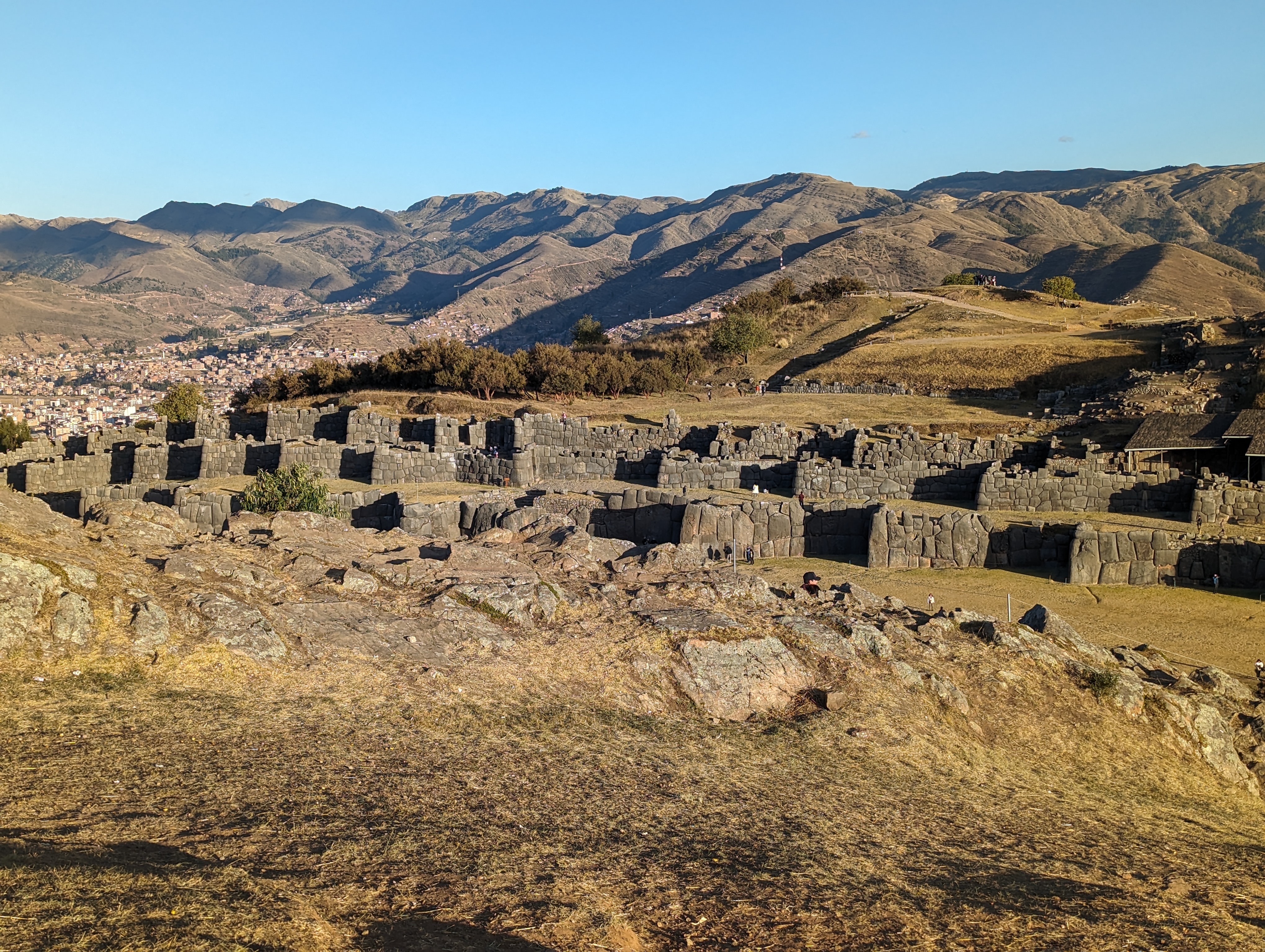
But of course this means we are back in Cusco. Back among the peddlers and Starbucks, among the rolling suitcases and “Oh my Gawds.” We take a day of rest and then see the rest of Cusco’s Inca ruins in a day, a 4 hour journey from the farthest ruin back into town ending at Sagsaywaman. This mighty fortress was where the Inca very nearly turned the tide, but in defeat where their fate was sealed. It is also where the festival of Inti Raymi is still celebrated to this day, proving that while empires can be crumbled, people will endure.
On our last day in Cusco we fell victim to that great bane of travel: Instagram. A completely unknown and out of the way mountain has become a major tourist attraction thanks to the magic of filters and influencers. Our trip to Rainbow Mountain begins at 3AM. After nearly being forgotten we are shoved into the two most uncomfortable shuttle seats of our entire trip for a 3 hour ride to the mountain. The hike to the mountain is a 2 hour affair that rises 1000 meters to just over 5000 meters above sea level. It is entirely uphill, entirely unshaded, and unfortunately rather bland. After so many impressive sights. So exhausting but stunning hikes, this one is nothing if not disappointing. The entire hike we are hounded by people trying to get us to take a horse, or buy a candy bar. When we finally reach the mountain, we are among 500 other people jockeying for position to pose for a photo in front a mountain that looks nothing like its press releases. The Rainbow Mountain, la Montana de Siete Colores, is just a half dozen shades of gray and rust. Behind it lies a much more picturesque glacier covered peak, but taking a picture in front of it on the giant stone hand costs extra. Bolivia would never.

So how does one asses our time in Cusco. A city I found so disappointing, a city so dependent on tourism it sacrificed its own identity. In reality I of course have no right to judge. The people of Cusco have a right to survive, and to attempt to thrive in whatever way they can. In catering to tourists, especially those from the US, they have found a path to prosperity. And after all Machu Picchu, the ruins of Cusco, the contents of the museum, they are their heritage, their culture, their legacy to carry and use as they see fit. I do not begrudge Cusco or its citizens. But I do not have to enjoy it. Though I will say this. If this is the tax extracted, so the world may have Machu Picchu, so the glory of the Sacred Valley can be shared, it is a small price to pay. I did not like Cusco and it did not matter because Machu Picchu was the goal. Machu Picchu is worth any cost.
1And imagine it you will have to do, neither of the two main cathedrals in the central square allowed photos.
2They do not make them well. Do not get a burger in La Paz.
3Another Big Church
4Also the huge amount of tourists means one of the hardest foods to find is local food. Also everything was too expensive. More on that later.
5I’m so sorry
6I saw it called both in official and unofficial cases so I have no idea what the town is called.
7We have got to come up with a word for what we are.
8 Using “Inca Ruler” for clarity, though it is inaccurate and redundant. There were no Inca people. Inca was the name of the ruling class of the empire. Thank Patricians in Rome, or the aristocracy of Medieval Europe.
 Slackerz Guide
It’s amazing how people can have such vastly different experiences of the same place. I guess that is why we travel! I visited Cusco in 2019 pre-COVID and don’t remember it being this busy or pushy at all. There were definitely some people trying to sell things but I could block it out quite easily and be left alone. In fact, Cusco was a nice comfortable base for all the many amazing things to see in this part of Peru with some creature comforts that we had missed while being on the road. Granted we didn’t spend a lot of time in the city as we stayed in Ollantaytambo also.